

Tenant screening is the most important thing you do as a landlord. Get it wrong and you're stuck in a nightmare tenancy or worse, facing a human rights complaint for asking the wrong question on an application form.
The rules in British Columbia are specific. There's the Residential Tenancy Act, the BC Human Rights Code and the Personal Information Protection Act (PIPA) — three different frameworks that all apply the moment you post a listing and start reviewing applicants.
This isn't a guide about how to spot red flags (we'll get to that). It's about building a screening process that protects you legally while still giving you the information you actually need to make a good decision.
Here's how to do it right.
What BC Law Actually Says About Tenant Screening
Three laws govern what you can and can't do:
- The BC Human Rights Code prohibits discrimination in housing based on protected grounds: race, colour, ancestry, place of origin, religion, sex, sexual orientation, gender identity or expression, age, marital status, family status, disability, and lawful source of income. If a tenant can tie your rejection of their application to one of these grounds, you have a problem.
- The Personal Information Protection Act (PIPA) governs how you collect and store personal information. The rule: collect only what you need, use it only for the purpose it was collected, and protect it from disclosure.
- The Residential Tenancy Act (RTA) sets the baseline rules for tenancy relationships in BC, including what happens when things go wrong.
None of these laws tell you who to rent to. But they all constrain *how* you decide.

What You Can Ask For (And What You Can't)
This is where most landlords get into trouble. Not from bad intentions, but from using generic application forms they downloaded off the internet.
You CAN ask about:
- Full legal name and contact information
- Current and previous addresses (to contact references and verify rental history)
- Employment status and employer name (not salary down to the dollar, but enough to verify they have income)
- References — previous landlords and personal references
- Move-in date and lease term preference
- Number of occupants (relevant to unit size and fire code, but not *who* they are)
- Pet ownership (if your unit has restrictions)
- Written consent to run a credit check
You CANNOT ask for:
- Social Insurance Number (SIN) — PIPA guidance is clear: a name and date of birth is usually sufficient to run a credit check. If you do include the SIN field on your application, it must be clearly optional, never required.
- Bank account numbers, balances, or full bank statements — this is more information than is necessary and creates unnecessary privacy liability for you.
- A blanket criminal record check — you can't make this a condition of tenancy in all cases.
- Number of children or their ages — falls under family status discrimination.
- Religious affiliation, country of birth, ethnic background
- Disability status or medical information
- Whether income comes from government assistance, disability payments, or other lawful sources — source of income is a protected ground in BC. You can verify amount, not source.
The guiding principle under PIPA: collect only what you need, for a purpose the applicant would reasonably expect.
How to Run a Credit Check Legally in BC
Credit checks are one of the most useful tools in your screening kit — but they come with a hard rule: you must have written consent before running one.
This is straightforward to comply with. Include a credit check consent clause in your rental application. Something clear: "By signing this application, I consent to the landlord obtaining a consumer credit report for the purpose of evaluating this tenancy application."
Keep that signed consent on file.
When reviewing the report, focus on:
- Payment history — especially rent-related accounts
- Outstanding collections or judgments
- Debt-to-income signals
A low credit score alone isn't necessarily a deal-breaker — context matters. A 22-year-old with thin credit is different from a 45-year-old with recent collections. Make your evaluation holistic.
Reference Checks: The Most Underused Tool
Most landlords either skip reference checks or do them as a formality. That's a mistake. A 10-minute call with a previous landlord tells you more than a credit report ever will.
When calling a previous landlord, ask:
- "Did [applicant] pay rent on time?"
- "Did they give proper notice when vacating?"
- "Was the unit returned in good condition?"
- "Would you rent to them again?"
That last question is the one that matters. People hedge on specifics but struggle to say yes to that directly if there were issues.
One flag to watch for: if the "previous landlord" has the same address as the applicant, or if the reference can't tell you when the tenancy started and ended, you may be speaking to a friend, not a landlord. Cross-reference with the address on the application.
The 5 Questions You Should Be Asking Yourself (Not the Applicant)
Legally defensible screening isn't just about what you ask — it's about how you *document and apply* your criteria consistently across all applicants.
Before screening anyone, define your criteria in writing:
- What minimum income-to-rent ratio do you require?
- What credit history factors matter most to you?
- How many references will you contact?
- What's your policy on pets?
- What lease term are you offering?
Apply the same criteria to every applicant. The moment you're flexible on a standard for one person and not another, you're exposed, especially if the person you rejected was in a protected category.
This isn't paranoia. It's documentation hygiene. And it's the difference between a defensible decision and an indefensible one.
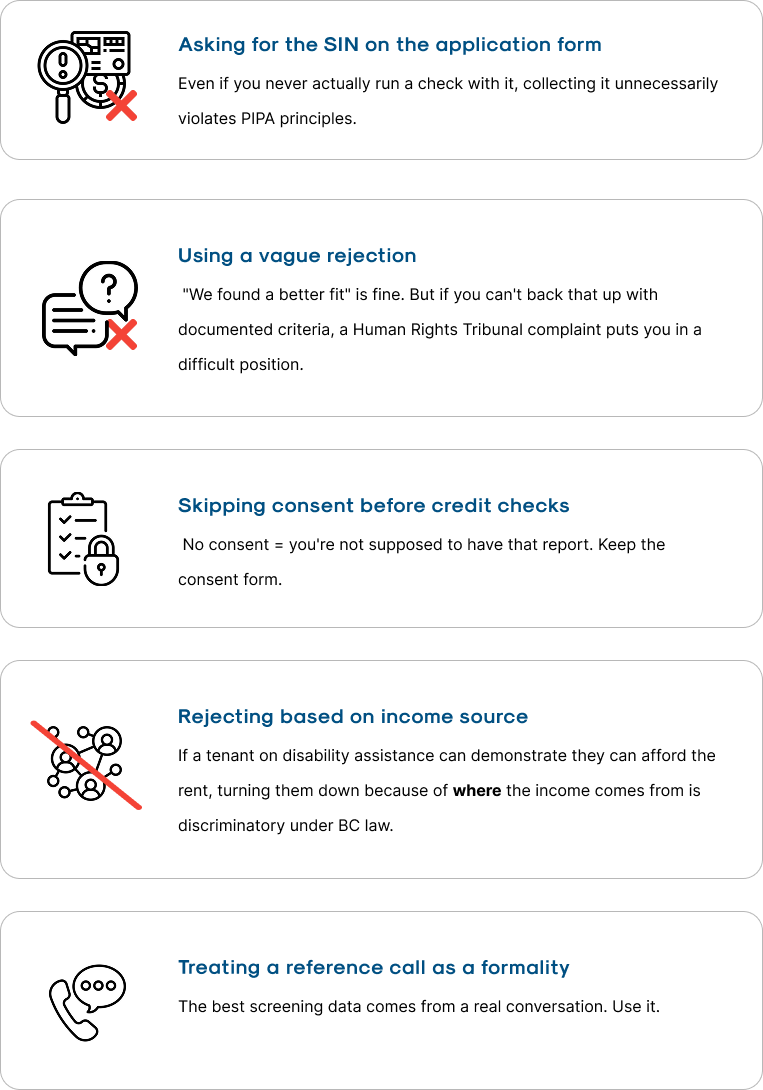
Common Mistakes BC Landlords Make
A Simple BC-Compliant Screening Process
Here's a repeatable flow that covers you legally and gives you the information you need:
- Post your listing with clear unit details, rent, and move-in date
- Use a written rental application that collects: name, current/previous addresses, employment info, references, occupants, pets, move-in date — and a signed credit check consent clause
- Review applications against your pre-defined criteria (income, references, credit)
- Run credit checks on shortlisted applicants (with consent already in hand)
- Call references — previous landlords first, personal references second
- Verify income using employment letter or pay stubs
- Document your decision — note which criteria the selected applicant met
- Inform unsuccessful applicants without disclosing information about other applicants
No fishing for protected information. No unnecessary data collection. No inconsistent standards.

Screen Smarter With Property Copilot
Even with the simple compliant process above, manual tenant screening takes time and creates compliance gaps — generic forms, missing consent clauses, no documentation trail.
Property Copilot's tenant screening tools are built specifically for Canadian landlords: digital applications with built-in consent language, credit and ID checks in one flow, and a screening process that keeps you on the right side of BC law from day one.
Start screening tenants the right way →
Sources:
- BC Human Rights Tribunal — Housing
- BC Office of the Human Rights Commissioner — Landlord Responsibilities
- TRAC — Human Rights
- Province of BC — List and Show a Rental Unit
- OIPC BC — Guidance Document: Private Sector Landlords and Tenants
- TenantsBC — 7 Things Landlords Can't Ask
- How to Verify Tenant Income in BC