

A landlord in Mississauga downloads a generic lease template from the internet. It looks professional. It has a place for names, rent, and a move in date. Nine months later, the tenant requests the official Ontario Standard Lease in writing. If the landlord does not provide it within the statutory timelines, the tenant may withhold one month's rent. If the landlord still does not provide it within 30 days after that, the tenant may keep that rent.
That kind of scenario is not rare. Recent landlord and paralegal blogs, drawing on Landlord and Tenant Board backlog data, warn that a contested eviction in Ontario can easily stretch over several months and cost a landlord many thousands of dollars in lost rent, legal fees, and administrative time. These are not official government performance targets, and actual timelines and costs can vary substantially depending on the facts of the case and current tribunal backlogs. Still, much of that time and cost traces back to one root cause: a lease agreement that was never built around the rules of the province it operates in.
Canada does not have one rental law. British Columbia, Ontario, and Alberta each run their own Residential Tenancy Act, their own dispute resolution body, and their own list of mandatory terms. A lease that is perfectly legal in one province can contain void clauses in another. This article breaks down why a province specific lease matters in BC, Ontario, and Alberta, and what it actually costs landlords who skip that step.
BC vs. Ontario vs. Alberta at a glance:
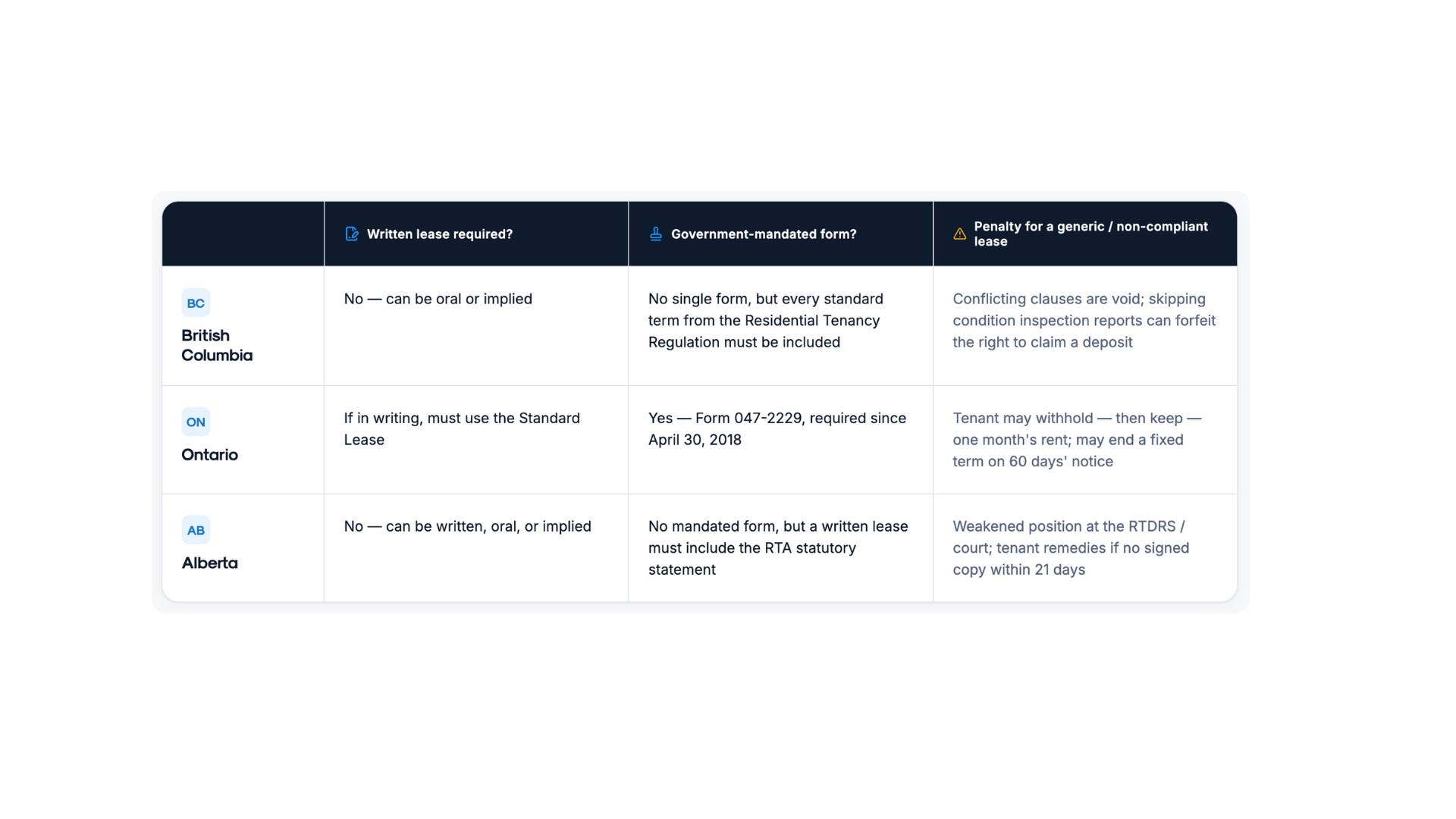
Why Province Specific Lease Agreements Matter
British Columbia
Under the BC Residential Tenancy Act (RTA), landlords are free to write their own tenancy agreement, but that agreement must include every standard term listed in the Residential Tenancy Regulation. Section 5 of the RTA states plainly that landlords and tenants cannot contract out of the Act, and section 6 adds that any term contradicting the RTA is unenforceable even if the tenant signed it. The province's own guidance gives a concrete example: a clause letting a landlord inspect a unit without notice is void, because section 29 requires at least 24 hours' written notice before entry, regardless of what the lease says.
In practice, a BC lease only protects a landlord to the extent it complies with the RTA's mandatory terms, because any conflicting clause is void and the standard terms still apply. Generic templates from other provinces or general contract libraries often miss required standard terms and may include entry, deposit, or fee clauses that are unenforceable in BC.
Ontario
Ontario takes this a step further. Since April 30, 2018, landlords entering into a written residential tenancy agreement have been required to use the government issued Standard Lease Agreement (Form 047 2229), with the updated version required for most leases signed on or after March 1, 2021. This applies to nearly all private residential tenancies: houses, apartments, condos, and secondary units like basement apartments. Some occupancy types, such as certain care homes, social housing, and mixed commercial and residential arrangements, fall under different rules or exemptions, so landlords with those property types should confirm which category applies before assuming the standard form is required.
The purpose is explicit. Before the standard form existed, many Ontario leases, including templates adapted from other jurisdictions, contained illegal terms such as blanket pet bans or extra damage deposits. Those clauses were always void under the Residential Tenancies Act, 2006, but tenants and landlords alike often did not realize it until a dispute reached the Landlord and Tenant Board.
Alberta
Alberta does not mandate a single government lease form the way Ontario does, and a tenancy agreement can even be oral or implied. But if a landlord puts the agreement in writing, the RTA requires a clear statutory statement stating that the tenancy is governed by the Residential Tenancies Act and that the Act prevails if there is a conflict. A generic lease pulled from a template site is unlikely to include this statutory statement and may not reflect Alberta specific rules such as deposit timelines and trust account requirements.
The Penalties and Disadvantages of Skipping a Province Specific Lease
British Columbia
Because BC tenants are guaranteed the RTA's protections regardless of what the lease says, a noncompliant lease does not protect a landlord the way they think it does. Common consequences include:
- Any clause that conflicts with the RTA (unauthorized entry, banned guests, disallowed fees) is simply unenforceable, so the landlord cannot rely on it in a dispute resolution hearing.
- Missing standard terms create ambiguity, and the Residential Tenancy Branch tends to interpret gaps against whichever party drafted the agreement, usually the landlord.
- Landlords who did not build proper condition inspection reports into their process, as required under the RTA, can lose the right to claim against a security or pet damage deposit entirely, even if there is damage.
If a dispute does escalate to ending the tenancy, our full breakdown of the BC eviction process walks through what that looks like.
Ontario
Ontario has some of the most concrete, quantifiable penalties in the country for skipping the mandatory form:
- If a landlord does not provide the Standard Lease within 21 days of a tenant's written request, the tenant may withhold one month's rent. If the landlord still has not provided it 30 days after that, the tenant may be entitled to keep that rent, so a small paperwork lapse can turn into a real financial loss.
- A tenant can also give 60 days' notice to end a fixed term lease early if the standard lease is never provided, something that would not be possible under a normal fixed term agreement.
- Illegal clauses copied from generic templates, most often no pets, extra damage deposits, or mandatory post dated cheques, are void even when signed. A landlord who tries to enforce one of these at the Landlord and Tenant Board typically loses the application and the filing fee along with it.
- Because disputes over unclear or noncompliant leases add to the Landlord and Tenant Board's caseload, landlords relying on generic templates are more likely to face the extended timelines and legal costs referenced above, though actual outcomes vary case by case.
Alberta
Alberta's penalties are less about a single missing form and more about lost leverage in a dispute:
- If a written agreement omits the required RTA statutory statement, it does not necessarily void the lease, but it weakens the landlord's position if the agreement is challenged before the Residential Tenancy Dispute Resolution Service (RTDRS) or in court.
- Fees or charges that are not clearly written into the agreement can be refused by the tenant, and if challenged, it becomes a matter for the RTDRS or the courts to decide based on the evidence presented, rather than a straightforward reference to the lease.
- If a tenant signs a written lease and does not receive a signed copy within 21 days, Alberta's RTA allows them certain remedies, which can include withholding rent until they receive the copy, so failing to provide one can significantly weaken a landlord's position.
llustrative Example
A landlord managing a single condo unit in Ontario used a lease template originally built for a US rental. It included a no pets, no exceptions clause and a separate damage deposit on top of last month's rent. When the tenant adopted a cat and later disputed the extra deposit, the landlord filed an application with the Landlord and Tenant Board to enforce the lease terms. Both the pet clause and the deposit were dismissed as void under the Residential Tenancies Act. The landlord lost the filing fee, several months of time waiting for a hearing, and ultimately had to refund the improperly collected deposit with interest.
When to Get Legal Advice
This article covers general rules, but some situations call for a licensed lawyer or paralegal rather than a blog post, including:
- Active evictions, rent withholding disputes, or deposit disputes already headed toward a hearing.
- Anything touching on human rights issues, such as disability related accommodation requests involving pets or service animals.
- Multi unit or commercial mixed properties where more than one set of rules might apply.
Using software that generates province specific lease agreements, reflecting Ontario's Standard Lease, BC's mandatory standard terms, and Alberta's statutory statement, removes much of this risk before a tenant ever signs.
How Property Copilot Helps
Property Copilot uses the official government issued lease forms for each province, so landlords in BC, Ontario, and Alberta sign agreements that are built to hold up, whether a dispute lands at the RTB, the LTB, or the RTDRS.
FAQ
Do I have to use the official Standard Lease form in Ontario?
Yes, for most private residential tenancies entered into on or after April 30, 2018. The current version applies to agreements signed on or after March 1, 2021.
Is a written lease legally required in British Columbia?
No. Tenancy agreements in BC can be oral or implied, but they must still include every standard term set out in the Residential Tenancy Regulation, whether or not anything is in writing.
Is a written lease legally required in Alberta?
No. In Alberta, residential tenancy agreements can be written, oral, or implied. However, a written lease is strongly recommended because it clearly records what the landlord and tenant agreed to and can help resolve disputes later. When a lease is put in writing, Alberta law also requires that it include a specific statutory statement about the Residential Tenancies Act, confirming that the tenancy is governed by that legislation and that the parties cannot contract out of it.
What happens if my lease includes a clause that breaks provincial rental law?
In all three provinces, a term that conflicts with the applicable Residential Tenancies Act is void and unenforceable, even if the tenant signed the agreement.
Disclaimer
This article is provided for general informational purposes only and does not constitute legal advice. Property Copilot is not a law firm, and this content should not be relied on as a substitute for advice from a licensed lawyer or paralegal. Rental laws in British Columbia, Ontario, and Alberta change over time, and how they apply can depend on the specific facts of a tenancy. Landlords and tenants with a specific legal question should consult a qualified legal professional or contact the relevant provincial tenancy authority (the Residential Tenancy Branch in BC, the Landlord and Tenant Board in Ontario, or the Residential Tenancy Dispute Resolution Service in Alberta).