

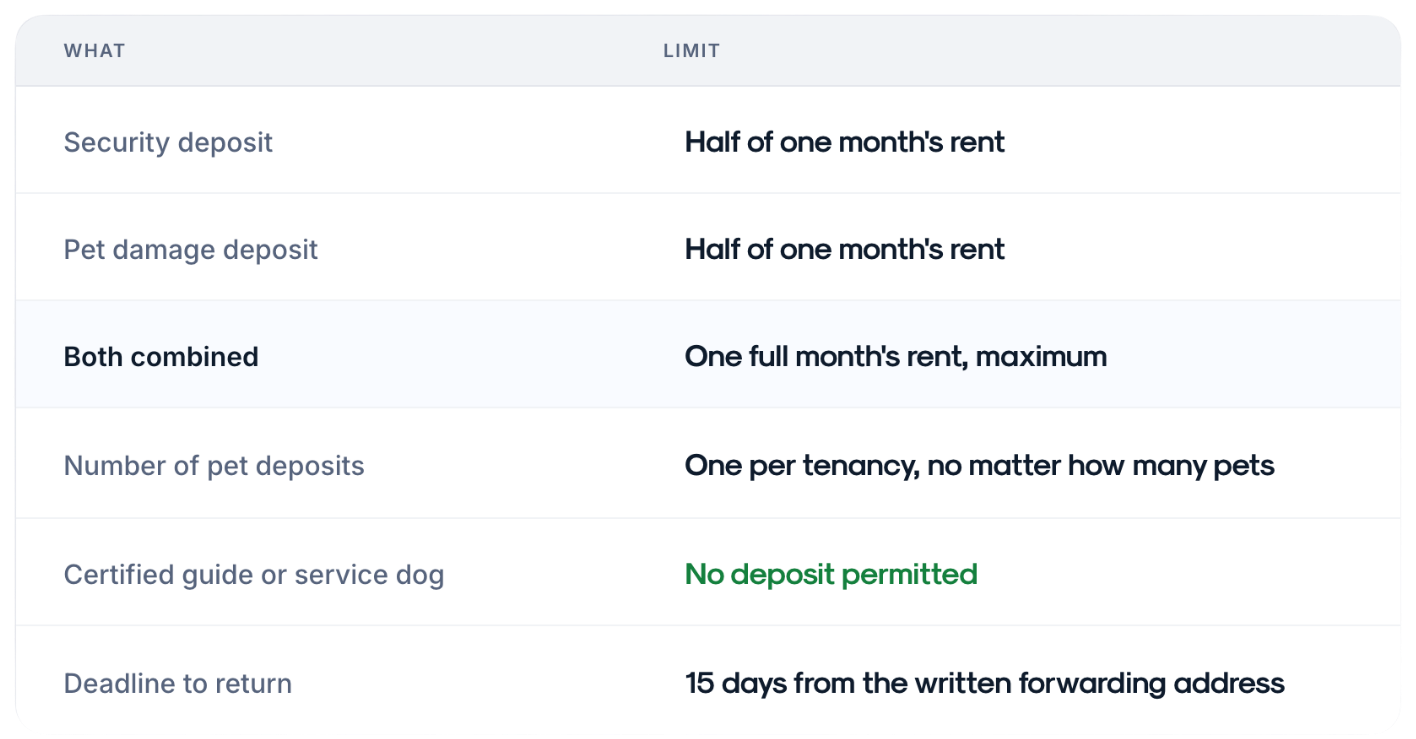
A security deposit in British Columbia can be up to half of one month's rent, and a pet damage deposit is a separate amount that can also be up to half of one month's rent. Together, a landlord can collect no more than one full month's rent in deposits.
TL;DR
The deposit limits are the easy part. Almost every deposit dispute in BC comes down to timing and paperwork. The 15 day return clock starts when you receive a written forwarding address, not when the tenant hands back the keys, and missing it can cost you double. Skipping the condition inspection can wipe out your right to claim for damage entirely, no matter how good your photos are. And a 0 percent interest rate this year does not mean zero interest is owed.
Table of Contents
- Deposit Limits at a Glance
- What Counts as a Security Deposit in BC
- Pet Damage Deposits
- When Pet Deposits Do Not Apply
- When the Tenant Has to Pay
- Returning Deposits
- What Happens If the Deadline Is Missed
- If the Tenant Never Sends a Forwarding Address
- Interest on Deposits
- Protecting the Right to Claim Against a Deposit
- Common Mistakes
- Frequently Asked Questions
Key Takeaways
- A security deposit is capped at half of one month's rent, based on the rent at the start of the tenancy.
- A pet damage deposit is separate and is also capped at half of one month's rent. A landlord can only collect one pet damage deposit, no matter how many pets are allowed.
- Certified guide dogs and service dogs are not pets, and no pet damage deposit can be charged for them.
- Once the tenant gives a forwarding address in writing, the landlord has 15 days to return the deposit with interest, get written consent to keep some of it, or apply to the Residential Tenancy Branch.
- Miss that deadline and the tenant can apply for double the deposit amount.
- For 2026 the interest rate is 0 percent, but interest is calculated year by year, so a deposit held since an earlier year may still owe interest.
Deposit Limits at a Glance
What Counts as a Security Deposit in BC
A security deposit, which most people in BC call a damage deposit, is money a landlord collects at the start of a tenancy and holds until it ends. Under the Residential Tenancy Act, the maximum is half of one month's rent, calculated from the rent in place when the tenancy begins.
If rent increases later, the deposit cap does not change. A tenant who signs a lease at $1,500 per month cannot be asked for more than $750, even if rent later rises to $1,650. There is no way to top up a deposit partway through a tenancy.
You can also only collect one security deposit per tenancy agreement, regardless of how many tenants are named on it. Two roommates on one agreement means one deposit.
The deposit covers unpaid rent and damage beyond normal wear and tear. It does not cover ordinary aging. Faded paint after four years is yours to absorb. A hole punched through a door is not.
If a landlord believes there is damage, the landlord cannot simply keep the money. That requires the tenant's written agreement or an order from the Residential Tenancy Branch.
Pet Damage Deposits
If pets are allowed, a landlord can require a separate pet damage deposit. Like the security deposit, it can be no more than half of one month's rent, regardless of how many pets are allowed under the tenancy agreement. Two cats and a dog still means one deposit.
A pet damage deposit can be collected when the tenancy begins or later, when the landlord agrees that a tenant may keep a pet. If the pet arrives partway through the tenancy, it is worth completing a fresh condition inspection at the same time.
What a landlord cannot do is turn the deposit into a recurring charge. There is no pet rent in British Columbia. A monthly pet fee charged instead of, or on top of, a pet damage deposit is an unenforceable term and will not survive a dispute.
If there is pet related damage, the landlord still needs the tenant's written agreement or an RTB order to keep any part of the deposit.
When Pet Deposits Do Not Apply
Certified guide dogs and service dogs are not treated as pets for deposit purposes. A landlord cannot require a pet damage deposit for a certified guide dog or service dog, and cannot refuse housing on that basis alone. The Province's guidance on pets and tenancy confirms this.
A landlord is allowed to ask for documentation confirming the dog is certified.
When the Tenant Has to Pay
This rule runs in the landlord's favour and very few people know it exists.
If the tenant does not pay the security deposit or pet damage deposit within 30 days of the date it was required to be paid under the tenancy agreement, the landlord can issue a One Month Notice to End Tenancy for cause.
Two things make that useful. The due date has to be written into the tenancy agreement, so vague wording weakens the remedy. And once the deposit is paid, the tenancy is established, which means the unit can no longer be rented to someone else.
Returning Deposits
The clock does not start at move out. It starts when the tenant gives the landlord a forwarding address in writing.
From the later of the tenancy end date or the date that address arrives, the landlord has 15 days to do one of three things:
- Return the deposit in full with interest.
- Get the tenant's written consent to keep some or all of it.
- Apply to the Residential Tenancy Branch for dispute resolution.
A landlord can return the deposit electronically, by mail, in person, or by leaving it in the tenant's mailbox or mail slot, and cannot charge a fee for returning it.
One detail that trips people up: written consent has to be real consent, given once the deductions are actually known. A clause buried in the tenancy agreement saying the tenant pre approves carpet cleaning is not consent, and arbitrators routinely disregard it.
What Happens If the Deadline Is Missed
If the landlord does not return the deposit, obtain written consent, or apply to the RTB within the 15 day window, the tenant can file a direct request with the RTB. An arbitrator can order the landlord to pay double the deposit amount.
That is not a ceiling an arbitrator works up to. It is the standard outcome. On a $1,500 combined deposit, the exposure is $3,000 plus the filing fee, and the original argument about the carpet stops mattering.
This is the most avoidable deposit dispute in BC. A single calendar reminder set on the day the forwarding address arrives is usually enough to prevent it.
If the Tenant Never Sends a Forwarding Address
Landlords are not required to chase a tenant forever. If the tenant does not provide a forwarding address in writing within one year after the tenancy ends, the landlord's obligation to return the deposit ends.
Do not treat that as a shortcut. Document every attempt to obtain the address, because the one year rule only helps if you can show the address never arrived.
Interest on Deposits
BC landlords must pay interest on security deposits and pet damage deposits. The rate is set each year under the Residential Tenancy Regulation at 4.5 percent below the prime lending rate of the Province's principal banker on January 1, compounded annually.
For 2026, the rate is 0 percent. Prime sat at 4.45 percent on January 1, which is below the 4.5 percent deduction, so the rate floors at zero for the year.
Here is where landlords lose money. A 0 percent year does not erase earlier years. Interest is calculated year by year across the whole period the deposit was held, using each year's published rate. A deposit taken in 2023 and returned in 2026 earned interest in the earlier years before flattening out. Returning only the original amount because the rate is zero hands the tenant a valid claim.
The RTB's deposit interest calculator handles the year by year math. Use it rather than estimating.
Protecting the Right to Claim Against a Deposit
This section decides whether a damage claim survives, and it has nothing to do with how much damage there was.
To keep the right to claim against a deposit for damage, a landlord has to run the condition inspection process properly at both ends of the tenancy. That means offering the tenant at least two opportunities to participate, with the second offered in writing using the approved form, scheduling between 8 a.m. and 9 p.m. unless both parties agree otherwise, completing the Condition Inspection Report, and giving the tenant a signed copy.
Skip that process and the right to claim against the deposit for damage is extinguished. Extinguished means gone. Photos, receipts, and contractor quotes do not bring it back.
The rule cuts both ways. If a landlord offered two proper opportunities and the tenant did not participate on either occasion, the tenant loses the right to the return of the deposit, and the landlord can complete the inspection and report alone.
Our guide to BC move in and move out inspections walks through the notice timing in full.
Common Mistakes
- Charging more than half a month's rent for either deposit.
- Charging a monthly pet fee instead of relying on the pet damage deposit.
- Starting the 15 day clock at move out instead of at the written forwarding address.
- Treating a pre signed clause in the tenancy agreement as consent to deductions.
- Offering only one inspection opportunity, or offering the second one verbally.
- Returning the deposit with no interest because this year's rate is 0 percent.
- Asking for a second deposit after a rent increase.
- Requiring a pet damage deposit for a certified guide or service dog.
FAQ
How much can a landlord charge for a security deposit in BC?
A landlord can charge up to half of one month's rent as a security deposit, based on the rent at the start of the tenancy. A later rent increase does not raise the cap.
Can a landlord charge a separate deposit for a pet?
Yes. A pet damage deposit is separate from the security deposit and can also be up to half of one month's rent. Together, the two deposits cannot exceed one full month's rent.
Can a landlord charge a pet deposit for each pet?
No. Only one pet damage deposit can be collected per tenancy, no matter how many pets are allowed.
Is a pet damage deposit required for a service dog?
No. Certified guide dogs and service dogs are not considered pets under BC rules, so no pet damage deposit can be charged for them.
Can a landlord charge monthly pet rent in BC?
No. BC allows a one time pet damage deposit of up to half a month's rent. A recurring monthly pet fee is not permitted and is unenforceable.
When does a tenant have to pay the security deposit?
Within 30 days of the date it is required to be paid under the tenancy agreement. If the tenant does not pay, the landlord can issue a One Month Notice to End Tenancy for cause.
How long does a landlord have to return a deposit after a tenancy ends?
Once the tenant gives a forwarding address in writing, the landlord has 15 days from the later of the tenancy end date or receipt of that address to return the deposit, obtain written consent, or apply to the RTB.
What happens if a landlord does not return the deposit within 15 days?
The tenant can apply to the RTB, and an arbitrator can order the landlord to pay double the deposit amount.
Do landlords have to pay interest on deposits?
Yes. The rate is set annually under the Residential Tenancy Regulation. For 2026 it is 0 percent, but interest is calculated year by year, so a deposit held since an earlier year may still owe interest.
Can a landlord keep a deposit without going through the RTB?
Only if the tenant agrees in writing, once the deductions are known. Otherwise the landlord needs an RTB order to keep any part of the deposit.
What if the tenant never provides a forwarding address?
If the tenant does not provide one in writing within one year after the tenancy ends, the landlord may keep the deposit.
Can a landlord ask for a bigger deposit after a rent increase?
No. The cap is based on the rent at the start of the tenancy, and there is no way to top up a deposit partway through.