

Two applicants can have the same credit score for very different reasons. One report may show a recent missed payment; the other may simply show a short credit history. The accounts, dates and notes behind the number tell you which it is, and what to ask next.
This guide walks through the common sections of a Canadian tenant credit report, including the R1 to R9 rating codes some reports use. It leaves the score until last so you see the details first. Layouts differ between credit bureaus and screening providers, so keep the legend that came with your report open as you read.
Before you interpret the report
Have consent and a clear purpose. Tell the applicant why you are checking their credit and get their consent before you request a report. Collect only what you need to assess the application, and store it securely. The Office of the Privacy Commissioner of Canada explains how privacy rules apply between landlords and tenants.
Note the report date. A credit report is a snapshot. Anything that changed after it was pulled won't appear.
Confirm the file belongs to your applicant. Compare the name, date of birth and current address with the application. Previous addresses are normal and can go back years. A mismatch is something to ask about, not proof that the applicant misled you.
A question it helps you ask: "This address isn't on your application. Is it an old address, or does it look wrong to you?"
Start with the accounts, not a verdict
The accounts section, sometimes called trade lines, lists each credit product reported for the applicant: credit cards, lines of credit, car loans, student loans and similar accounts. For each one, look at:
- Account type: revolving (such as a credit card), instalment (a loan with fixed payments) or open (paid in full each month).
- Date opened: how long the account has existed.
- Limit or original amount, and current balance.
- Payment history: whether payments were made on time and, if not, how late.
- Last reported date: when the lender last sent an update. Bureaus update reports at least once a month, according to the Financial Consumer Agency of Canada (FCAC), but each account has its own reporting date.
Then look across the accounts together. One late payment three years ago, on an account that has been current ever since, reads differently from several late payments in recent months. No single line is a verdict on the applicant or a forecast of how they will pay rent.
A question it helps you ask: "The report shows a late payment on this account in [month]. Has that been caught up?"
What do R1, R9 and the other codes mean?
Some credit reports show a rating made of a letter and a number, such as R1 or I2. The letter is the account type and the number is the payment status. Each rating describes one account, not the applicant overall.
Letters: R = revolving · I = instalment · O = open · M = mortgage
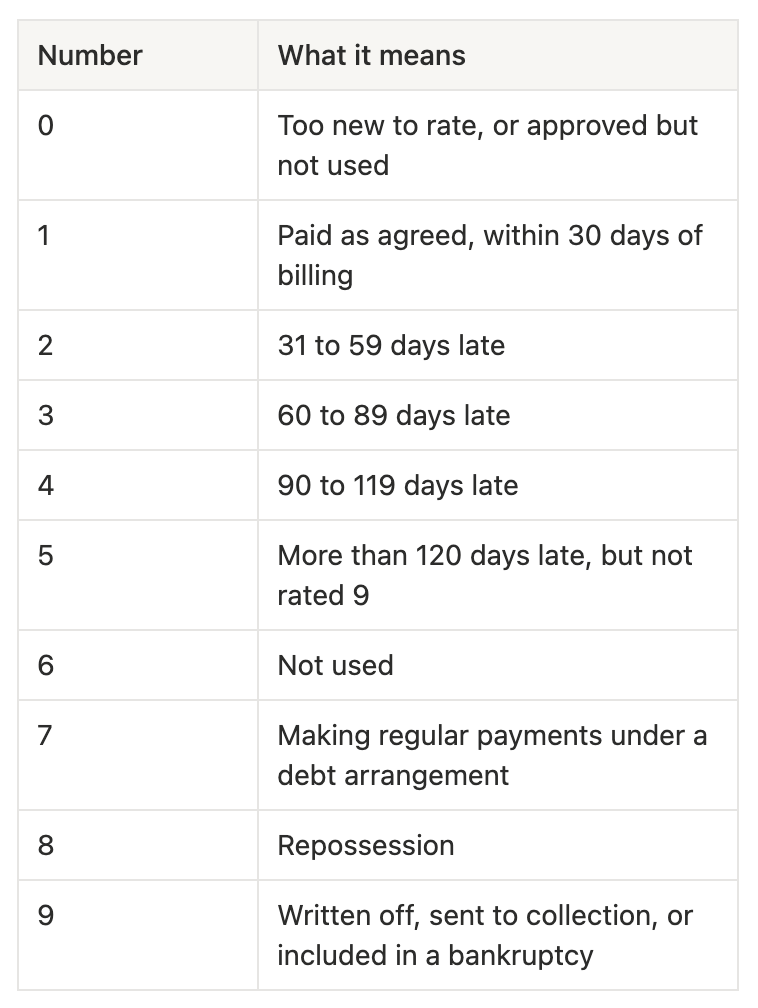
Source: FCAC, Understanding your credit report and credit score (2016), pages 11 to 12. A general reference; always follow the legend on your report.
A few codes are easy to misread:
- 0 is not negative. It usually means there isn't enough history yet.
- 6 is not a rating. It is unused in this legend, so it tells you nothing either way.
- 7 covers more than one situation. Payments are being made under an arrangement, such as a consumer proposal or a debt management program.
- 9 covers several outcomes. It can mean a write-off, a collection or a bankruptcy. The account details tell you which.
The numbers aren't a ranking of applicants. Each one describes how a single account was paid at the time it was reported.
Not every report uses these codes. The report in Property Copilot, for example, describes payment history in plain language instead: on time, 30, 60, 90 or 120+ days late. The information is the same; only the label differs.
Read inquiries, collections and public records in context
Inquiries
An inquiry records a credit check. The type matters:
- Hard inquiries commonly come from applications for credit, such as a loan or credit card. They can affect the applicant’s credit score. Some rental applications also involve a hard inquiry.
- Soft inquiries do not affect the applicant’s credit score. Checking your own report is one example.
A rental application does not automatically generate a hard inquiry. The type depends on the check the screening provider runs. Before ordering a report, confirm whether the provider uses a hard or soft inquiry so you can explain it accurately to the applicant.
When reviewing inquiries shown on the report, look at the type, date and organization that requested the check. Several entries close together need context; an inquiry does not mean credit was granted or that the applicant took on new debt. Ask for clarification before drawing conclusions from the number of inquiries alone.
Source: Financial Consumer Agency of Canada, Improving your credit score.
A question it helps you ask: “Do you recognize this inquiry from [month], and what was it for?”
Collections
A collection entry shows a debt that a creditor passed to a collection agency. Check the original creditor, the amount, the date it was assigned and whether it is marked paid or unpaid. The same debt can appear twice: once on the original account (often rated 9) and again as the collection. Don't assume a collection is rent-related unless the report says so.
A question it helps you ask: "Is this collection still outstanding, paid, or being disputed?"
Public records and consumer statements
Public records can include bankruptcies, consumer proposals and court judgments. Note the date and current status of each.
A consumer statement is a short note the applicant has added to their file, for example to explain a dispute or a period of hardship. It gives you context, but it isn't independent proof that an entry is wrong. If the applicant believes information is inaccurate, they can dispute it with the credit bureau.
Walk through one fictional account
Fictional example for illustration only. Not a real bureau report.
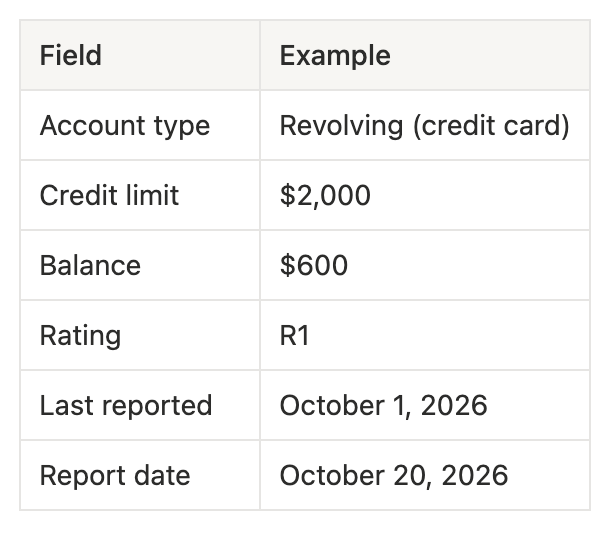
Reading it field by field:
- R1: R means a revolving account; 1 means payments were made as agreed.
- Balance and limit: $600 of a $2,000 limit is 30% used on this account when it was reported. That's one account at one moment, not the applicant's overall credit use, and not an approval threshold.
- Last reported date: the account was updated on October 1, while the report was pulled on October 20. The balance may have changed during that gap.
A question it helps you ask: "Has anything changed on this account since the report was updated?"
Put the score back in context
Canadian credit scores usually range from 300 to 900 (FCAC). Scores from different providers, or from the same provider on different dates, aren't always identical, and there is no single score every landlord should require.
A credit report also leaves out much of what you need to know. It doesn't confirm identity, show income or describe how someone treated a previous rental. Read it alongside identity verification, income documents and reference checks.
A thin file, or no Canadian credit history, is not the same as a poor payment record. In Ontario, for example, the Ontario Human Rights Commission says a lack of credit or rental history should not be viewed negatively. If your applicant is new to Canada, see screening an applicant with no Canadian credit history.
Using Property Copilot for credit screening
Property Copilot keeps the application, supporting documents and identity verification together. When you're ready to review an applicant's credit, order an Equifax-powered report from their application for $25. The applicant consents through the application, and the soft inquiry does not affect their credit score.
The report shows the bureau's credit score and Property Copilot's 100-point summary as two separate figures, with account summaries and payment history in plain language. Both help you read the file; neither makes the decision for you.
Sign up for Property Copilot
FAQ
Can an applicant give me their own credit report instead?
They can share it, and it may be useful context. A file or screenshot on its own doesn't show whether it's complete or current, though. A report you request through a screening provider, with the applicant's consent, comes directly from the source and is dated the day you order it.
Will a landlord's credit check affect the applicant's score?
Not every rental application generates a hard inquiry. A hard inquiry can affect the applicant’s score; a soft inquiry does not. The credit check in Property Copilot is a soft inquiry. If you use another provider, confirm the inquiry type before ordering the report.
How often is a credit report updated?
Bureaus update reports at least once a month, but each account updates when its lender reports. Check the last reported date on the accounts that matter to you.
What if the report shows an address I don't recognize?
It may be an old address, a mailing address or an error. Ask the applicant about it. If they believe it's wrong, they can dispute it with the bureau. Don't treat it as fraud without verification.