

TL;DR
A blank credit file and a damaged credit file are not the same thing, and the gap between them is where good applicants get lost. When the file is thin, you are not screening blind. You are screening with a different set of evidence, and the only discipline that matters is knowing which parts of that evidence you have actually confirmed and which parts you have simply been handed.
At a Glance
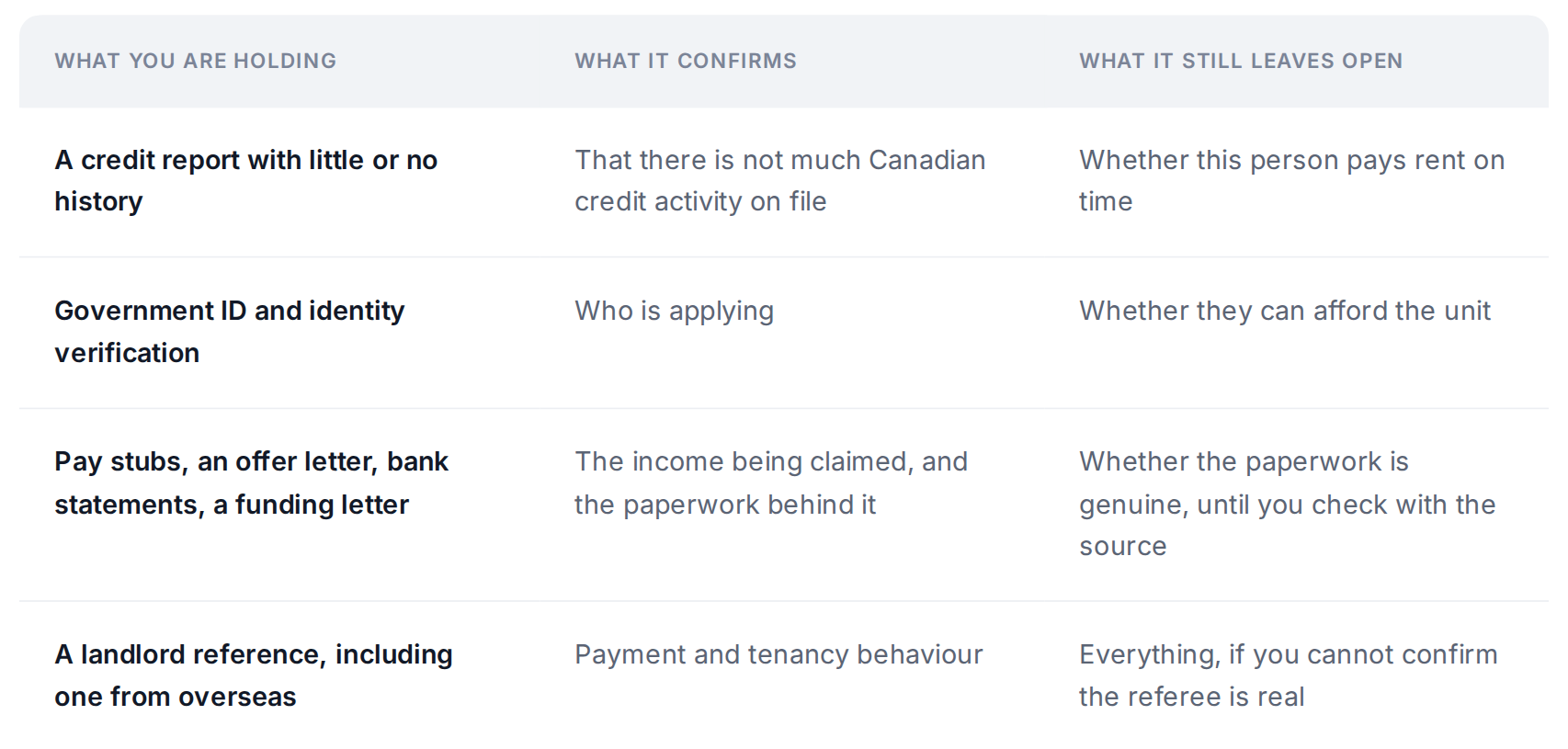
Table of Contents
- An Empty File and a Bad File Are Not the Same Thing
- Who Actually Shows Up With a Thin File
- Sort the Application Into Confirmed, Claimed and Unknown
- Making an Overseas Landlord Reference Usable
- What This Looks Like on a Live Application
- What Goes Wrong Here
- What You Can Ask For in BC, Ontario and Alberta
- Where Property Copilot Fits
- FAQ
An Empty File and a Bad File Are Not the Same Thing
Two applicants can both arrive without a credit score, and the two situations point in opposite directions.
One has missed payments, collections and a file the bureau is perfectly happy to score, badly. The other has almost nothing on file because they have not borrowed money in Canada. The first is information. The second is the absence of information, and those call for different responses.
The mechanism is simple enough. Canadian credit reports are built from what lenders report to the country's two main bureaus, Equifax and TransUnion, and as the Financial Consumer Agency of Canada puts it in its credit report and score basics, those bureaus "only collect information about your credit activity in Canada." No Canadian accounts, nothing to report. That is the whole story.
It is worth adding that even a full credit report looks backwards. FCAC notes that information about late or unpaid credit cards and loans stays on file for up to six years. A credit report describes borrowing that already happened. It was never built to tell you whether someone pays rent.
Who Actually Shows Up With a Thin File
Mostly people who are early in something.
Statistics Canada studied this directly in Immigrant credit visibility: Access to credit over time in Canada, published September 2023. Families who had landed less than two years earlier were credit invisible at 14.8 percent, roughly double the 7.5 percent rate for comparable Canadian born families. The study defines credit invisible as not having enough credit history for an agency to calculate a score.
The more useful finding is what happens next. The gap does not just narrow, it reverses. Families who had been in Canada two to four years were slightly more credit visible than comparable Canadian born families. So a thin file at month nine tells you how long someone has been here. It does not tell you who they are.
International students, renters in their early twenties and people who have deliberately avoided debt land in the same place, for the same structural reason.
Sort the Application Into Confirmed, Claimed and Unknown
Here is the habit worth building. Take every piece of the application and drop it into one of three buckets.
Confirmed means you went to an independent source and it matched. Claimed means the applicant told you, or handed you a document saying so, and you have not checked it. Unknown means nobody has an answer, including the applicant.
Most weak screening decisions come from quietly moving something out of the claimed bucket without doing the work. Below is how the three main pieces of a thin file application usually sort.
Identity
Identity verification confirms that the person applying is the person on the documents. That is genuinely important, and it is the first thing that fails in a fraudulent application. Our guide to tenant identity verification in Canada covers how that check works.
It is also a gate rather than a grade. Knowing exactly who someone is tells you nothing about whether they can pay for the unit. If you only take one thing from this article, take the fact that these are two separate questions with two separate answers.
Income and Supporting Documents
Collecting a document and verifying a document are different acts, and a complete application is not a verified one. A tidy file is the easiest kind to fake, because the person assembling it controls every field.
For a newcomer or a student the paperwork simply looks different from what you are used to, and different is not weaker:
- An employment offer letter with the first two or three pay stubs, instead of two years of T4s
- Bank statements showing the deposits, which is the cheapest cross check you have, because you can compare what the pay stub says against what actually landed
- A scholarship, assistantship or funding letter for a student
- A letter of employment from an HR contact you reach on a number you found yourself, not the one printed on the letter
That last point carries the whole section. Verification means returning to the source through a channel the applicant did not supply.
Rental References
For an applicant with no credit file, a previous landlord is the single most valuable item in the package, because it is the only evidence that speaks directly to the behaviour you care about.
Ask for the two most recent tenancies rather than the one the applicant volunteers. And keep the distinction between a character reference and a landlord reference firmly in mind, because they answer different questions and people submit the first hoping it reads as the second.
Making an Overseas Landlord Reference Usable
An overseas reference is not weaker than a domestic one. It is harder to corroborate, which is a solvable problem rather than a reason to discount it.
Confirm the Referee Before You Trust the Reference
- Ask for the property address, then look it up yourself and see whether the name attaches to anything public
- Search the phone number and the name separately and note whether they line up
- If it is an agency rather than an individual, call the company's main line instead of the direct number you were handed
- Ask for the tenancy agreement or rent receipts, and check that the names, address and dates match what the referee tells you
Six Questions Worth Asking
Keep them factual, answerable, and identical for every referee you call:
- What were the exact start and end dates of the tenancy?
- What was the monthly rent, and how was it paid?
- Was rent ever late, and how often?
- Was the deposit returned in full?
- Did they give proper notice when they left?
- Would you rent to them again?
The dates and the rent amount do the heavy lifting, because you can check both against the lease and the bank statements already in your hands. If the referee's version and the paperwork disagree, that disagreement is real information.
When There Is No Reference at All
Some applicants genuinely have none. A student who lived in family housing, someone in their first tenancy, someone from a place where a written tenancy agreement was not standard. Name that to yourself as a gap rather than treating it as a strike, then lean harder on what you can confirm and write down honestly what stayed unknown.
What This Looks Like on a Live Application
The following is hypothetical, written to show the reasoning rather than to describe a real applicant or a real report.
Your applicant moved to Canada nine months ago and works at a hospital. Their credit report shows one secured card opened five months ago and nothing else. They have submitted a letter of employment, three pay stubs, four months of bank statements, government ID, and a landlord reference from their previous country.
Confirmed: identity, through document checks during the application. The deposits in the bank statements match the net amounts on the pay stubs month over month. The employer exists, and HR confirmed the role and start date when you called the hospital's published main line. The overseas property address is real, and the referee's name appears connected to it publicly.
Claimed: the stated household budget and the plan to stay two years.
Unknown: there is no Canadian record of housing payments, because there has not been time for one to exist. The overseas referee could confirm the tenancy but not the rent amount, because the agency changed hands. The employment is nine months old, which is a short track record regardless of where someone comes from.
That is not a verdict, it is an accurate picture. Two landlords could read it and decide differently based on the unit, their own tolerance and the rest of the applicant pool, and both would be reasoning properly. What matters is that the decision rests on the confirmed column rather than on the blank space where a score usually sits.
What Goes Wrong Here
Reading an absence as a negative. The most common error by a distance. No file gets treated as a bad file, and a solid applicant loses out to someone with a mediocre score and a worse rental history.
Letting complete pass for verified. Every field filled, every document uploaded, nothing checked with a third party. Our checklist for avoiding fake rental applications goes further on this.
Treating identity as a financial check. Two questions, two answers. Confirming who somebody is does not tell you what they can afford.
Leaning on a score built from very little data. A number produced from a thin file is a fragile thing to hang a tenancy on. Weight any input by how much evidence sits behind it.
Running a different process for different applicants. Improvising extra requirements for the unfamiliar file and waving through the familiar one leaves you with information you cannot compare. The same checklist for everyone is what makes a side by side comparison possible.
What You Can Ask For in BC, Ontario and Alberta
Three provinces publish their own guidance for landlords, and the overlap is larger than the differences. All three treat income information, references and credit checks as things a landlord may request, with consent attached to the credit check. The differences worth knowing:
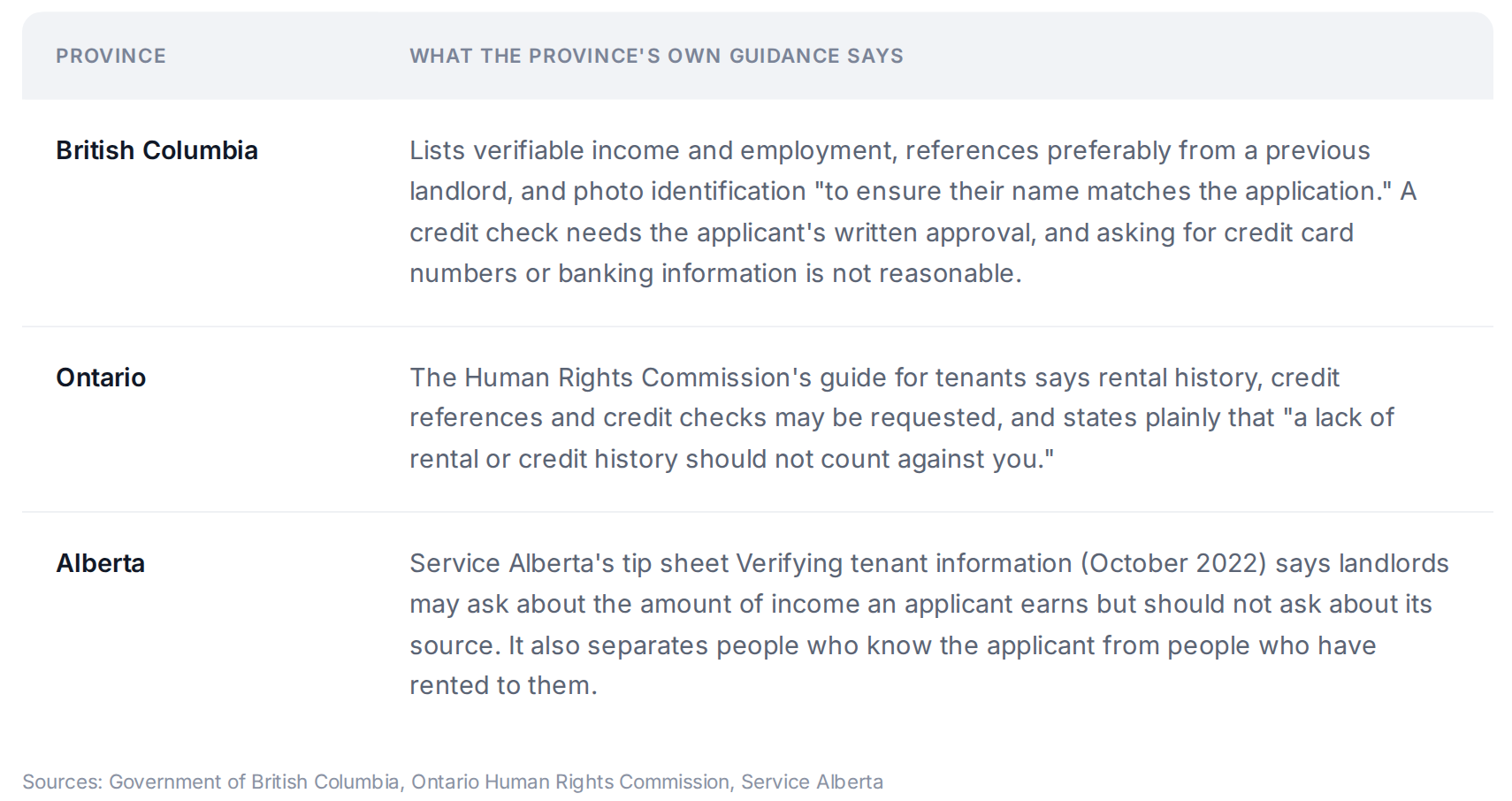
Check the current guidance for your own province before you finalise your application form.
Where Property Copilot Fits
It helps to be precise about which layer does what, because these get blurred constantly.
The Application
We collect the application and the supporting documents in one place, with identity verification built into the application step, so you are not chasing files across email and text. Every applicant moves through the same structured intake, which is what makes a like for like comparison possible in the first place.
The Screening Report
Ordered separately once the applicant has completed their application and verified their identity. The report includes Equifax credit information, the Property Copilot Score, public records, and AML screening covering politically exposed persons, sanctions lists, negative news and law enforcement and regulatory checks. Two boundaries worth stating out loud: AML screening is not an identity or liveness result, and it is not a comprehensive criminal record check.
What Stays With You
Calling the employer, comparing the pay stubs against the bank deposits and phoning the previous landlord are still your work. Our job is making sure everything arrives in one place, in the same shape, from every applicant, so that the work you do is worth doing.
One last thing that matters for this particular applicant. Equifax Canada's own guidance on how to build credit in Canada lists rent reporting among the ways to start a file: "Paying your rent monthly and reporting it to Canada's credit bureaus is a smart way to build up your credit without taking on debt." We offer optional rent reporting to Equifax Canada, which means the tenant you place today with no file can have one a year from now. For a renter who has been shut out of housing for having no history, that is not a small thing, and it gives you a reason to be the landlord they stay with.
Start free and set up your next rental application with the same structure for every applicant. Screening reports are ordered and priced separately when you need one.
FAQ
Is no credit history the same as bad credit?
No. A poor score reflects credit activity that went badly. An empty or thin file usually means there has not been much Canadian credit activity to report. Ontario's Human Rights Commission states that a lack of rental or credit history should not count against an applicant.
Who typically has little or no Canadian credit history?
Mostly people who are early in something. Statistics Canada found that families in Canada less than two years were credit invisible at 14.8 percent, roughly double the 7.5 percent rate among comparable Canadian born families, and that families here two to four years were slightly more credit visible than comparable Canadian born families. International students, renters in their early twenties and people who avoid debt also tend to have thin files.
Does credit history from another country show up on a Canadian credit report?
No. The Financial Consumer Agency of Canada says the bureaus only collect information about credit activity in Canada, though it notes some lenders may look at a credit history from another country if the person provides that report.
How do I verify income when an applicant has no Canadian credit file?
Compare the pay stub amounts against the deposits on the bank statements, then confirm the role with the employer using a phone number you looked up yourself rather than the one printed on the letter. Collecting a document and verifying a document are different steps.
What should I ask an overseas landlord reference?
Ask factual questions you can cross check: the exact tenancy dates, the monthly rent and how it was paid, whether rent was ever late, whether the deposit came back in full, and whether they would rent to the applicant again. Before the call, confirm the referee is real by looking up the property address and the phone number independently.
Can rent reporting help a tenant with a thin credit file?
Yes. Equifax Canada lists reporting monthly rent payments to the credit bureaus as a way to build credit without taking on debt. Property Copilot offers optional rent reporting to Equifax Canada, so on time rent from a tenant with no file starts contributing to one.