

“Were they a good tenant?” produces an opinion. Asking when rent was due, whether payments arrived on time and what happened when a problem arose produces details a landlord can check.
A useful reference call has three parts: confirm who is on the line, ask about the tenancy and follow up on anything that matters to the decision. Use these ten questions as a conversation guide, and skip any that have already been answered. The notes below each question explain what to listen for and when to follow up.
The privacy and human-rights examples below focus on BC, Ontario and Alberta. Check the rules that apply where the rental is located.
Before the call: permission and a contact check
Confirm the applicant’s consent. Explain who will be contacted and that the purpose is to assess their rental application. Keep a record of that permission, including permission to contact a current landlord. If a different reference is needed, check that the consent covers that contact before proceeding. BC’s privacy guidance addresses consent for reference collection and limits the exchange to tenancy-relevant information. BC guidance, section 11
Check the contact route. For a management company, find its official website independently and call its main number. Ask for the named person and confirm their role. A company email address is helpful supporting information, but it does not prove every claim made in a reply.
Know what needs to be established. Have the application ready. Note the tenancy dates, rent and any specific discrepancy that needs clarifying. Avoid collecting unrelated details just because someone offers them.
Opening the reference call
First confirm the person’s name and role. Once it is clear the intended reference is on the line:
Hi, this is [landlord’s name]. [Applicant’s name] has applied to rent from me and gave me permission to contact you for a reference. Do you have a few minutes? Were you the owner or property manager at [rental address], and roughly when did you look after the property?
If the referee needs evidence of permission, arrange an appropriate way to provide it. Do not send the applicant’s entire application.
Let the referee supply the answers. “What was the monthly rent?” is more useful than reading a figure aloud and asking them to agree.
Ten questions to ask a previous landlord
Confirm the tenancy
1. “Can you confirm the address they rented from you and roughly when they lived there?”
Compare the answer with the application. If the tenancy is ongoing, record that. An approximate month recalled years later is different from a substantial unexplained mismatch.
2. “How much was their monthly rent?”
Check the period as well as the amount; rent may have changed. Past rent is a fact to verify, not a ceiling on what the applicant can afford now.
Understand the payment record
3. “When was rent due, and did they generally pay on time?”
Establish the agreed deadline before labelling a payment late. Ask about any agreed changes to the payment date.
4. “Were there any late or missed payments? How often did that happen, and did they get caught up?”
Focus on the last year of the tenancy, or the whole tenancy if it was shorter. Ask for dates, frequency, amounts where relevant and whether the issue was resolved. A remembered concern is different from a payment record. If the answer matters to the decision, identify what needs clarification rather than treating a vague description as settled fact.
Ask about care and specific concerns
5. “Did any issues come up during the tenancy that we haven’t covered? How were they handled?”
Keep follow-ups to tenancy-related issues and what the referee directly observed. If a lease obligation comes up, ask which one. Do not assume that a written lease term was enforceable, or treat a disability-related accommodation as misconduct.
6. “Were there any complaints involving them? What did you find out, and how did things turn out?”
A complaint alone does not establish what happened. Ask about dates, findings and resolution without collecting neighbours’ personal details. If the referee only knows that someone complained, record that limit.
7. “How did they look after the place? Did they let you know when something needed fixing?”
Separate damage from ordinary wear and from a request for repair. Ask for examples. Raising a maintenance concern is not itself a negative reference.
Understand the ending and unresolved issues
8. “Are they still renting from you? If not, what led to them moving out?”
Ask for the factual sequence where relevant. A tenant’s repair complaint or use of dispute resolution is not, by itself, evidence of poor tenancy conduct. Avoid turning the call into a judgment about whether the applicant was agreeable.
9. “After they moved out, were there any cleaning or repair costs you asked them to cover? Was that settled, or is anything still disputed?”
An invoice or demand does not, on its own, establish the applicant’s responsibility. Ask what supports the claim and whether the outcome is known. Do not ask for a whole dispute file when a specific clarification will do.
10. “Would you rent to them again? Why or why not?”
Use this as an optional summary, not a pass/fail test. If the answer introduces another concern, ask the same factual follow-ups. A yes without detail and a no based on personal dislike are both limited evidence.
Close with: “Thanks, that’s helpful. Is there anything we’ve discussed that you’d like to clarify?”
If email works better
After confirming the contact route and consent, use this opening and include the ten questions above:
Subject: Rental reference request for [applicant’s name]
Hi [name],
[Applicant] has applied to rent from me and gave me permission to contact you about their tenancy at [rental address]. Were you the owner or property manager, and roughly when did you look after the property?
I’ve included a few questions below. Please answer what you can from your own experience or records. If you don’t know or can’t remember something, just say so.
There’s no need to send their full file or include personal or medical details unrelated to the tenancy. If you’d like confirmation of their permission, let me know. I’m also happy to arrange a quick call if that’s easier.
Thanks for your time,
[Name and contact details]
A short scheduling text, once the recipient is confirmed:
Hi [name], this is [landlord’s name]. [Applicant] authorized a rental reference check. Would [time option] suit a brief call, or would email be easier?
What to do when the details do not line up
Ask the applicant about a specific discrepancy without accusing them of dishonesty:
The dates your reference gave me are a little different from the ones on your application. Can you help me clear that up? When did you move in and move out?
Give a reasonable opportunity to respond. Consider whether a targeted lease extract, rent receipt or payment confirmation would resolve the gap. Allow unrelated personal and financial details to be redacted.
For a second tenancy reference, use another person with direct knowledge of the rental, with the applicant’s consent. An employer may help verify relevant employment information, but cannot usually confirm rent payments or property condition.
If a manager only confirms dates or declines to comment, record the limitation. Neither silence nor general praise proves that the reference is false.
Optional: check the property record
A title search may help resolve an ownership question. It does not authenticate the person on the phone or establish that they managed the tenancy.
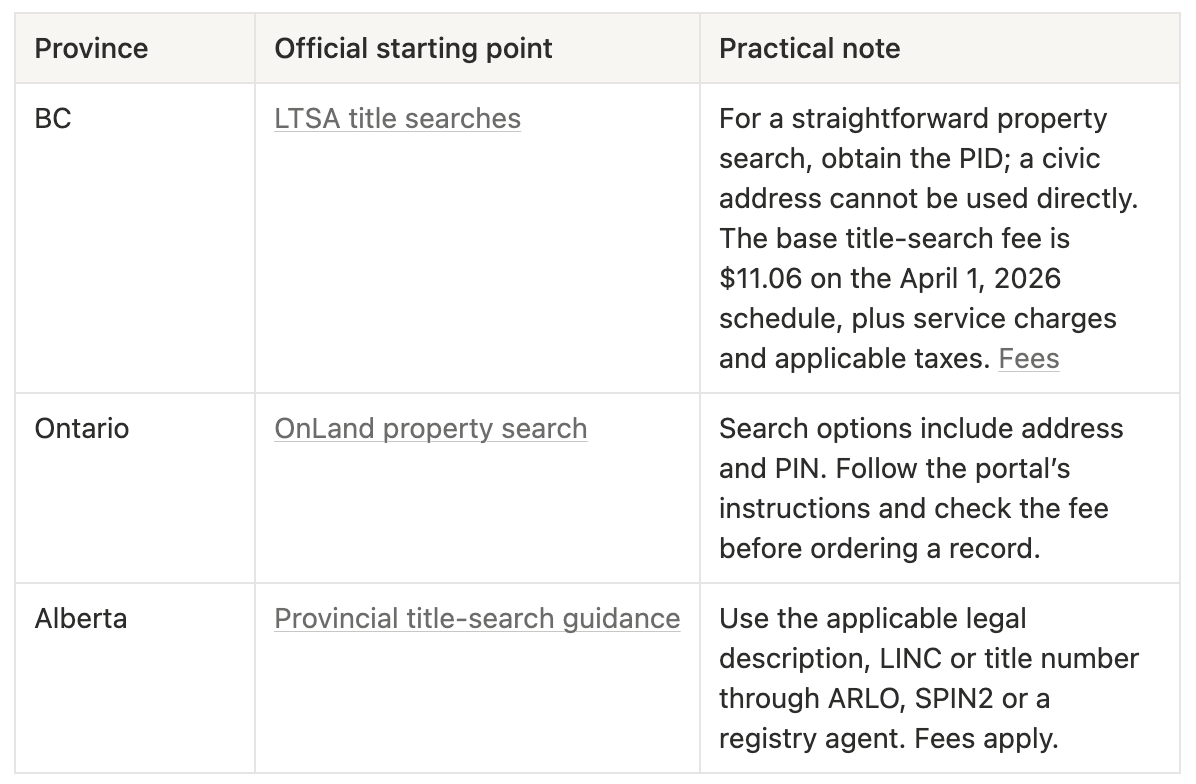
A current title concerns current registered ownership. A former owner or property manager may not appear. LTSA notes that its title does not supply a phone number or a chain of past owners; a mailing address on title is not confirmation that the contact is the right referee. LTSA records guidance
Use another source where it can answer the question more directly.
Keep personal matters out of the reference conversation
Do not ask a previous landlord about the applicant’s family plans, religion, race, sexuality, medical history or disability. Keep income-source questions out of this call; the relevant payment question is whether rent was paid as agreed.
Protected grounds and accommodation obligations differ by province. BC’s landlord guidance and Alberta’s rental-housing guidance explain why screening decisions need to avoid discriminatory assumptions.
If personal information is volunteered, redirect the discussion: “This call is only about confirming the tenancy facts.” Keep irrelevant details out of the reference assessment. Handle any accommodation request for the rental separately and appropriately.
If there is no previous landlord
A first-time renter may have no landlord reference. A newcomer may have a useful reference outside Canada.
Explain what information is still needed and consider appropriate alternatives: an overseas landlord, relevant payment records or financial evidence that addresses the actual gap. Use email when language or time zones make a call difficult.
Do not add a guarantor automatically because there is no Canadian history. Ontario’s guidance distinguishes missing rental history from a poor record and warns against requiring guarantors simply because an applicant belongs to a protected group. A guarantor policy requires its own assessment. OHRC guidance
The Property Copilot guide to an applicant with no Canadian credit history discusses related screening considerations.
Keep a short record of what the reference confirmed
Use the same core fields, while leaving room for information that is unavailable or needs clarification:
- Applicant, date, referee’s name, role and relevant management period.
- Consent record and how the contact was checked.
- Tenancy address, dates and rent: what was reported and what was confirmed.
- Payment history: agreed due date, specific issues and known outcome.
- Other relevant concerns: allegation, supporting information, response and resolution.
- Information unavailable or still unresolved.
- Applicant’s explanation and any follow-up.
- Decision and the relevant reasons for it.
Hypothetical note: “Referee reports one payment received four days after the agreed due date. Referee says it was paid in full; no record reviewed. Applicant’s clarification pending.” This preserves the information without turning “one late payment” into “unreliable tenant.”
Store the notes securely with access limited to those who need them. Set retention according to the applicable law and legitimate needs. In BC, personal information used for a decision directly affecting an applicant must be kept for at least one year after use. BC PIPA, section 35
Applicants may have access and correction rights. Follow the applicable process, including exceptions for third-party information; do not promise either absolute secrecy or automatic release of an unredacted file. Alberta privacy guidance · Federal privacy guidance
Where Property Copilot fits
Property Copilot brings applications and supporting documents together, with applicant identity verification before submission. That provides an organized file to work from.
Applicant identity verification does not verify a reference contact or the statements they make. The reference call and assessment remain separate steps.
FAQ
Should a landlord check references for every applicant?
Focus on applicants under serious consideration, with consent and a clear purpose. Use the same core tenancy questions, then tailor follow-ups to relevant gaps. Consistency should not prevent appropriate alternatives or accommodation.
What if the previous landlord does not respond?
Try a reasonable follow-up through the checked contact route. Then discuss another reference or targeted supporting records with the applicant. Record the reference as unavailable, rather than treating a missed call as evidence of a poor tenancy.
Does a negative reference mean the application should be declined?
First establish what the criticism is based on, whether it is relevant and what remains disputed. Give the applicant an appropriate opportunity to clarify material discrepancies, and assess the available information together.