

Most landlords do not lose money because they made a bad call. They lose money because they had nothing to back the good call up when it mattered. A tenant stops paying. A notice gets challenged. A term gets disputed. Now you need to prove something you never expected to have to prove, sometimes for months.
Below are the four gaps that cost BC landlords the most in a dispute, backed by real numbers where they exist, updated for 2026
Key Takeaways
- Verbal tenancy agreements are legally recognized in BC, but a written, signed agreement is what actually holds up when a term is disputed.
- A 10 Day Notice or a One Month Notice each require the correct form and timeline under the Residential Tenancy Act. A single wrong detail — the wrong date, the wrong form, service done incorrectly — is enough to get an application dismissed and send a landlord back to day one.
- Statistics Canada's Canadian Social Survey found that difficulty paying rent is the second most common reason tenants report being evicted nationally, and nearly six in ten evicted renters were struggling financially around the time they were evicted.
The Checklist
- You skipped real tenant screening
- You never got anything in writing
- You do not have a clean rent payment record
- You do not know your current notice rules
1. You Skipped Real Tenant Screening
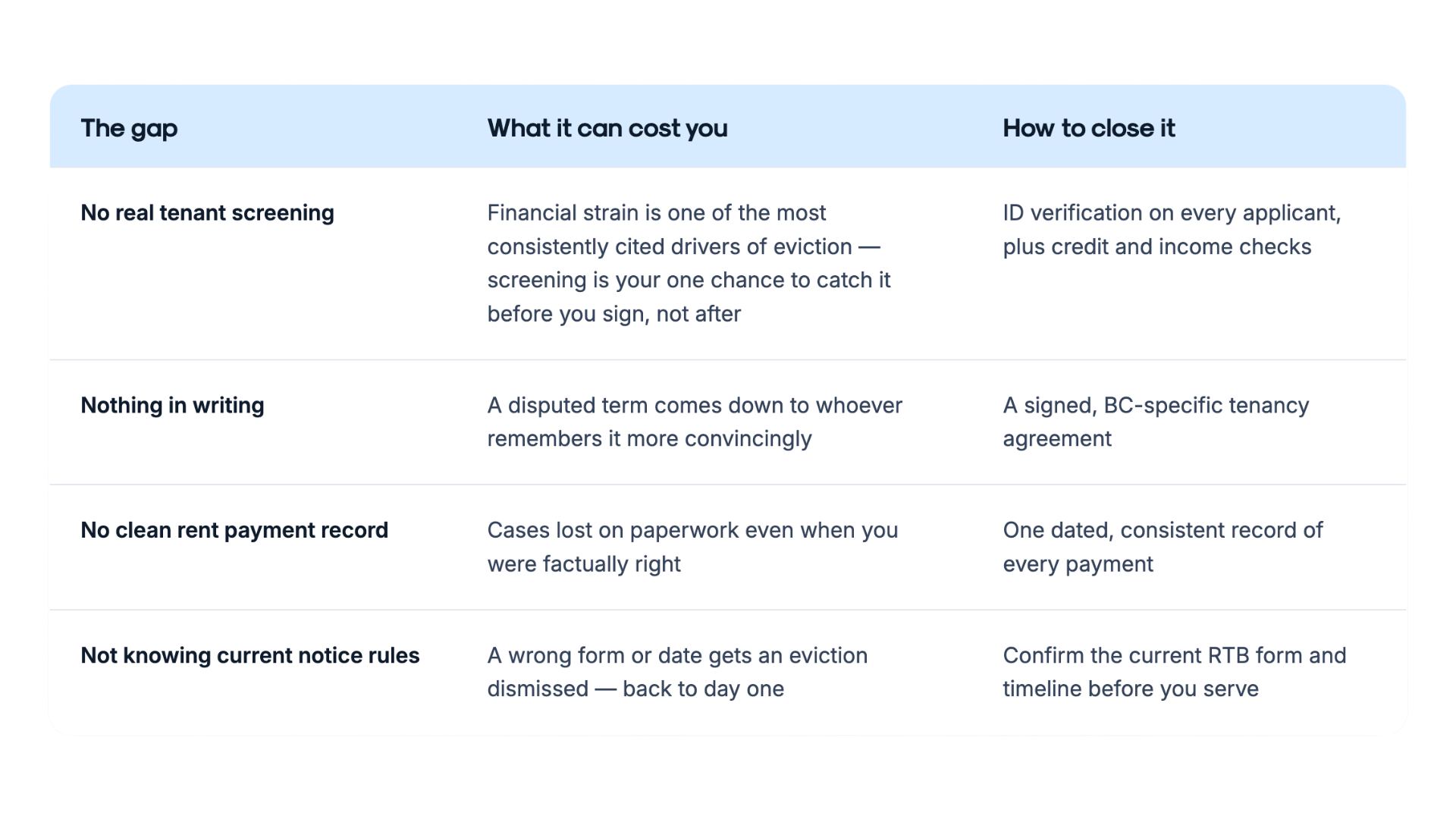
This is the most measurable item on the list, even without a marketed dollar figure to point to. Statistics Canada's Canadian Social Survey found that difficulty paying rent is the second most common reason tenants report being evicted, behind only a landlord reclaiming the unit for personal use, and that nearly six in ten evicted renters were already finding it difficult or very difficult to meet their financial needs around the time they were evicted. Financial strain tends to show up well before it becomes a dispute.
Landlords generally know screening matters. The gap is that a real share still skip or shorten the process anyway, usually because a vacancy needs filling faster than a credit check and income verification come back. The fix is to screen before you ever book a viewing, not after — here is how to screen tenants before a viewing in Canada.
2. You Never Got Anything in Writing
BC legally recognizes verbal tenancy agreements. The Residential Tenancy Branch also says plainly, in its own official guidance, that a written agreement is what actually protects you if a term is disputed later, because a verbal understanding comes down to whoever remembers it more convincingly.
If a term matters — the rent amount, what is included, the condition at move in — put it in the signed agreement, not a hallway conversation. BC runs its own Residential Tenancy Act with its own mandatory terms, so a lease copied from a generic template or borrowed from a different jurisdiction rarely holds up here. More on why generic leases fail: signed doesn't mean enforceable.
3. You Do Not Have a Clean Rent Payment Record
This one is increasingly about time, not just accuracy.
The Residential Tenancy Branch reports cutting dispute resolution wait times by an average of 70 percent since November 2022 — its most recent figures, published in 2025 — with a standard hearing now scheduled in about nine weeks instead of roughly sixteen, and fast tracked unpaid rent or utility disputes moving in around a month.
Even with that improvement, a payment dispute is not something you sort out in a few days. Your records may need to hold up for a month or more, depending on how the dispute is scheduled and whether either side requests an adjournment. A scattered mix of e transfers, cash, and cheques is hard enough to reconstruct after a month. It is often the reason landlords lose cases they were factually right about.
4. You Do Not Know Your Current Notice Rules
There is no published figure for how many landlord notices get thrown out on technical grounds, so the short version matters more than a number. A 10 Day Notice to End Tenancy for Unpaid Rent (RTB-30) and a One Month Notice to End Tenancy for Cause (RTB-33) each have their own form and their own timeline under the Residential Tenancy Act, and getting either wrong — the wrong termination date, the wrong form, service done incorrectly — is enough to get an eviction application dismissed even when the underlying reason is legitimate.
%2520(1).png)
Always confirm the current form and timeline with the RTB before serving — requirements change.
We walk through the full process, form by form, in what the eviction process actually looks like in BC.
Confirm your current requirements before you serve anything, not while you are drafting under pressure. BC's current forms and requirements are published directly through the Residential Tenancy Branch.
How Property Copilot Helps
Every scenario above comes back to the same problem: landlords are running a business without the structure that business needs, because nothing was built for them specifically. Here is how Property Copilot lines up against each one.
Screening starts with ID verification on every applicant by default, with Equifax powered credit screening available whenever you want to go deeper before approving someone. Unverified applicants and tire kickers self select out, so you are choosing between people who have already proven who they are, not people who seemed trustworthy in a first conversation.
Written terms run through compliant, BC specific lease templates with e-signatures built in, so the signed agreement — not a hallway conversation — defines the relationship from day one. Learn how the signing side works in our guide to digital lease signing in Canada.
Notice procedures are the one item that stays on you. Property Copilot keeps your applications and lease organized and ready to hand over, but knowing your current Residential Tenancy Branch requirements is still something every landlord needs to confirm directly. We can hand you a clean file. We cannot serve the notice for you.
Most independent and small portfolio landlords are not missing another place to list a property. They are missing the layer underneath it — the part that turns screening and signing into a documented, defensible record. That is what we mean when we call Property Copilot the front end of leasing.
FAQ
What records should landlords keep to protect themselves in a dispute?
At minimum, keep the signed tenancy agreement, a dated record of rent paid and owed, any notices you sent and how you sent them, and records of the screening decision for each tenant. If it is not written down and dated, treat it as something you cannot prove later.
How common is late or unpaid rent for BC landlords?
Common enough that Statistics Canada tracks it at the national level. In its Canadian Social Survey, difficulty paying rent was the second most cited reason tenants gave for being evicted, just behind a landlord reclaiming the unit for personal use. How much a specific case costs scales with how long it drags on, which is the real argument for screening properly at the start rather than managing the fallout later.
Is a verbal agreement with a tenant enforceable in BC?
Yes. BC legally recognizes verbal tenancy agreements. It is just far harder to prove and enforce than a written one, which is why the Residential Tenancy Branch recommends a written agreement even though it is not always required.
What happens if a notice has an error on it?
It gets dismissed, and the landlord has to start the process over from the beginning. Notice requirements are specific and unforgiving, so confirm your current requirements with the Residential Tenancy Branch before you serve one.
Does better screening actually reduce the risk of a dispute?
Yes. Financial strain is one of the most consistently cited drivers of eviction and dispute activity in Canada, and screening is the point in the relationship where a landlord has the most ability to catch that risk before signing a lease rather than after.
Disclaimer: This article is general information, not legal advice. Tenancy laws, timelines, and notice requirements are fact specific. Confirm your current requirements with the Residential Tenancy Branch or a licensed professional before acting.