

A leaking faucet does not become a legal problem the moment it starts dripping. It becomes one the moment you ignore it long enough for a tenant to write it down.
Repairs are the second most common issue facing BC tenants, behind only eviction, according to the Tenant Resource and Advisory Centre. Most of that volume is not landlords refusing to fix things out of spite. It is landlords who genuinely did not know where their obligation started, where it ended, or what a tenant is actually allowed to do about it when a repair sits unaddressed.
Under BC's Residential Tenancy Act, landlords must maintain the rental unit and any included services or appliances in a condition that meets health, safety, and housing standards, while tenants are responsible for cleanliness and for damage beyond reasonable wear and tear. Emergency repairs follow a separate statutory process, and ordinary repair disputes must usually go through the Residential Tenancy Branch rather than rent withholding. Here is what that actually looks like in practice.
Key Takeaways
- Under RTA section 32, a landlord's duty to meet health, safety, and housing standards comes from the statute itself. A lease cannot lower or override it, though what applies to a specific defect still depends on the facts.
- Tenants are never responsible for reasonable wear and tear, though whether something counts as wear and tear or damage is a factual question, not a fixed list. Tenants are generally responsible for cleanliness, minor upkeep, and damage they or their guests cause.
- Emergency repairs have their own legal definition and their own process, including a requirement that every landlord provide a written emergency contact.
- A tenant generally cannot withhold rent over an ordinary repair without a Residential Tenancy Branch order. Ignoring a legitimate repair request instead exposes a landlord to a repair order, a rent reduction, or a monetary order.
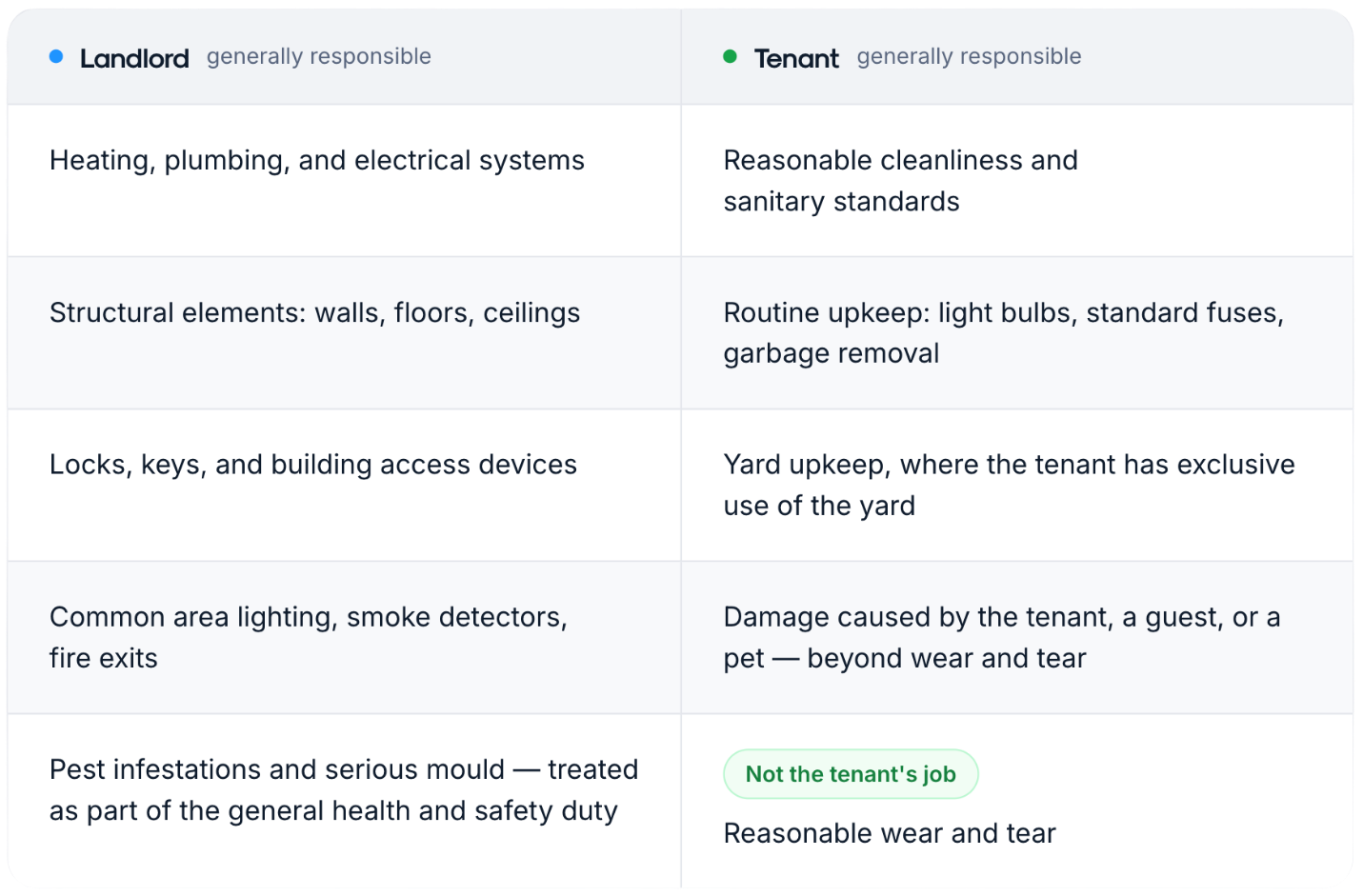
At a Glance: Who Fixes What
These are common categories drawn from RTB guidance and TRAC resources, not a fixed or exhaustive list. What actually applies to a given unit depends on the tenancy agreement, local bylaws, and the specific facts.
1. What the RTA Actually Requires You to Repair
Section 32 of the Residential Tenancy Act sets the baseline. A landlord must provide and maintain residential property that complies with the health, housing, and safety standards required by law, and that is suitable for occupation given the age, character, and location of the unit. That statutory duty exists whether or not a tenant knew about a problem when they signed the lease, and a tenancy agreement cannot lower or override it, though that does not mean every defect in every circumstance is automatically the landlord's responsibility. Whether a specific issue falls within the duty still depends on the facts.
Section 32(1) sets the legal standard itself: health, safety, and housing compliance, plus suitability for occupation. The RTA does not spell out a detailed list beyond that. RTB Policy Guideline 1 and TRAC's own guidance map that general standard onto a longer working list of items landlords are generally expected to handle:
- Heating, plumbing, and electrical systems
- Walls, floors, and ceilings
- Locks, keys, and building access devices
- Common area lighting, fire doors, fire escapes, and smoke detectors
- Elevators, where applicable
- Painting and exterior window cleaning at reasonable intervals, where a local Standards of Maintenance bylaw or the tenancy agreement calls for it, rather than as a blanket duty in every tenancy
- Routine yard maintenance and any necessary tree work in multi unit buildings, where it is required by a local bylaw or specifically included in the tenancy agreement, since yard responsibility otherwise depends heavily on what the lease actually says
Pest infestations, including bed bugs, and serious mould problems are generally treated as part of this same health and safety duty under RTB Policy Guideline 1 and TRAC guidance, even though the RTA itself does not name them as separate statutory categories. If a specific item is not in your lease and is not clearly a health or safety issue, treat it as a case by case question and check RTB Policy Guideline 1 rather than assume either way.
2. What Actually Falls on the Tenant
Section 32(2) puts a separate, narrower obligation on the tenant: maintain reasonable health, cleanliness, and sanitary standards. That generally covers routine carpet care, wiping down baseboards, removing garbage, replacing light bulbs and standard fuses, and yard upkeep if the tenant has exclusive use of the yard.
The distinction that matters most in a dispute is wear and tear versus damage. Under section 32(4), a tenant is never responsible for reasonable wear and tear, meaning the ordinary deterioration that comes from age and everyday use. They are responsible for damage beyond that, caused by themselves, a guest, or a pet.
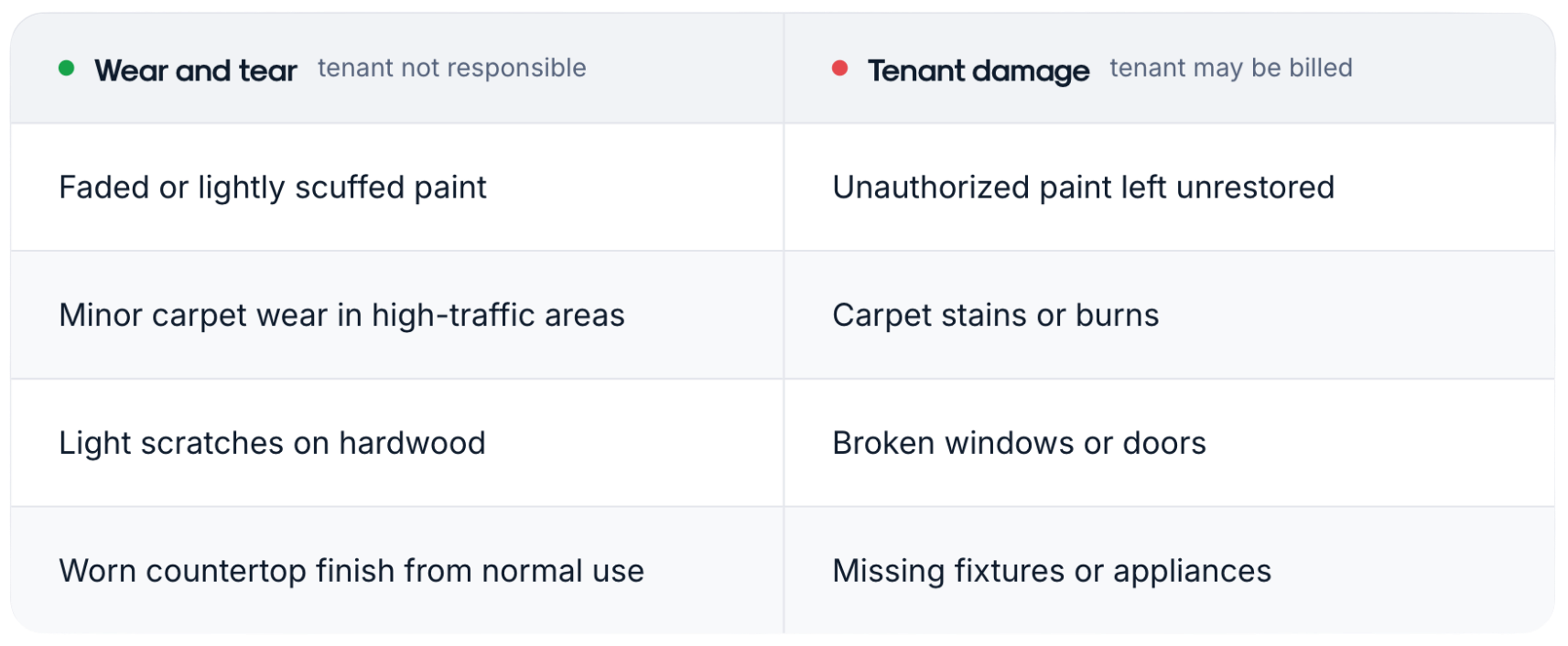
These are common examples, not an exhaustive or universal list. Whether something counts as wear and tear or damage is a factual question an arbitrator decides based on the specific unit, how long the tenant lived there, and how the item was used, so treat the table as a guide rather than a rulebook. When damage does happen, RTB Policy Guideline 40 sets out the expected useful life of building elements. A landlord cannot bill a tenant for the full replacement cost of a carpet that is already ten years old and only had five years of useful life left in it. Compensation gets prorated against that schedule. For how to document a unit's condition at move in and move out so these disputes don't come down to memory, see our BC move-in and move-out inspections guide.
3. Emergency Repairs Have Their Own Rules
Section 33 defines an emergency repair narrowly. It must be urgent, necessary for the health or safety of someone or the preservation of the property, and it must fall into one of five categories.
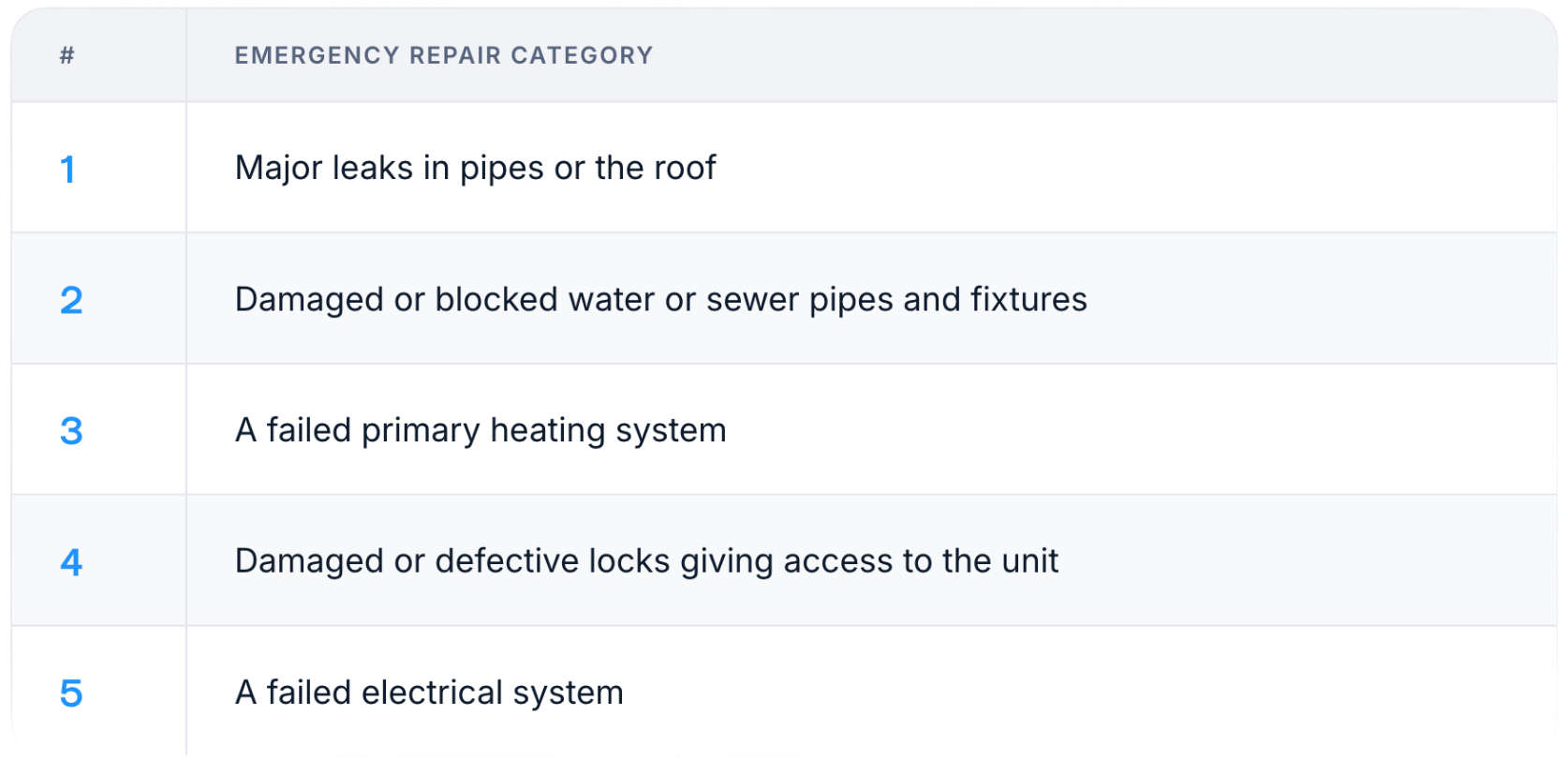
The legal test always starts with those three elements, urgent, necessary for health or safety or preservation of property, and within one of the five listed categories. A clogged bathroom sink or a broken dishwasher usually fails that test since neither is on the list, even if it feels urgent to the tenant living with it, unless the specific facts meet it some other way.
Section 33 expects every landlord to provide the name and phone number of an emergency contact in writing or post it in a visible common area on the property. If a tenant cannot reach that contact after at least two attempted calls with a reasonable interval between them and the repair cannot safely wait, they have the right to arrange the emergency repair themselves and seek reimbursement, either by billing the landlord directly or deducting the documented, reasonable cost from rent. That right depends on following the statutory process, not just on the repair feeling urgent: the tenant generally needs to be able to prove the two call attempts and show that the price paid was reasonable, or they risk losing the right to reimbursement entirely. This is the one part of the RTA that catches landlords managing their own properties off guard most often, simply because it is easy to set up an emergency contact once and then forget to keep it current after a phone number changes.
4. What Happens If a Repair Request Gets Ignored
Outside the emergency repair process covered above, a tenant generally cannot legally withhold rent over an unresolved repair without a Residential Tenancy Branch order permitting it. Rent is still due in full while an ordinary repair dispute works its way through the system. What a tenant can do is notify the landlord in writing, document the problem with photos or video, and if nothing happens within a reasonable period, file an Application for Dispute Resolution with the RTB.
At a hearing, an arbitrator can issue a repair order compelling the landlord to fix the problem, a rent reduction for the period the unit was not properly maintained, or a monetary order for related losses. The filing fee is one hundred dollars under the RTB's published fee schedule at the time this was written, but confirm the current figure directly on the RTB's site before filing, since fees can change. A written record works both ways: a landlord who responded promptly and kept a paper trail has a straightforward defence, while one who has nothing but a memory of a hallway conversation does not.
Two other RTA provisions matter here. First, if a repair requires entering the unit, section 29 generally requires at least twenty four hours of written notice stating the reason and the proposed time, with entry falling between eight in the morning and nine at night unless the tenant agrees otherwise. Second, many BC municipalities, including Vancouver, Surrey, Richmond, and Victoria, run their own Standards of Maintenance or Good Neighbour bylaws that go further than the RTA on specifics like heating, hot water, and building exteriors. It is worth checking whether your city has one, since it can be used as evidence in a dispute even when it is not the RTA itself doing the work.
If the work you are planning goes beyond an ordinary repair and genuinely needs the unit vacant, that is a different legal process entirely. See our guide to BC renovation eviction rules. For the wider picture of what else tends to go wrong for BC landlords at a hearing, our checklist on what actually puts BC landlords at risk in a dispute covers the other four gaps beyond repairs.
Because nearly all of this comes down to a written trail, the request, your response, the dates, and the photos, keeping that record in one place rather than scattered across texts and email is what turns a dispute into a straightforward defence instead of a conflict of memories.
FAQ
Who is responsible for repairs in a BC rental?
Under RTA section 32, the landlord must maintain the rental unit and any included services or appliances in a condition that meets health, safety, and housing standards. That generally covers things like heating, plumbing, electrical systems, and structural elements, though the specific list depends on the tenancy agreement, local bylaws, and the facts. Tenants are responsible for reasonable cleanliness and any damage beyond normal wear and tear.
What counts as an emergency repair in BC?
Only five categories qualify: major leaks in pipes or the roof, damaged or blocked water or sewer pipes and fixtures, a failed primary heating system, damaged or defective locks, or a failed electrical system. The issue must also be urgent and necessary for health, safety, or preserving the property.
Can a tenant withhold rent if a landlord will not fix something?
Not for an ordinary repair dispute, no, not without a written order from the Residential Tenancy Branch. Rent must still be paid in full while that plays out. The one exception is a properly documented emergency repair the tenant paid for themselves after following the required steps, which can be deducted from rent or reimbursed.
What is the difference between wear and tear and tenant damage?
Wear and tear is the ordinary deterioration that comes from age and everyday use, and a tenant is never responsible for it. Damage caused by a tenant, their guests, or their pets beyond that baseline is the tenant's responsibility to pay for.
How long does a landlord have to make a repair in BC?
The RTA does not set a fixed number of days. It requires action within a reasonable time, which an arbitrator decides based on how serious the issue is and how long the landlord has known about it. A failed furnace in January and a sticking cabinet door are not judged on the same clock.
What can happen if a landlord ignores a valid repair request?
A tenant can apply to the RTB for a repair order, a rent reduction for the period the problem went unaddressed, or a monetary order for related losses. The filing fee is one hundred dollars per the RTB's published fee schedule at the time this was written, but confirm the current figure directly with the RTB before filing.
Disclaimer: This article is general information, not legal advice. Tenancy laws, timelines, and notice requirements are fact specific. Confirm your current requirements with the Residential Tenancy Branch or a licensed professional before acting.