

If you're renovating a tenanted unit in BC, the Residential Tenancy Act sets firm rules on process, permits, and rent, and it treats a renovation very differently from a demolition. Get the process wrong and the penalty can reach twelve times the monthly rent. Here's the whole thing broken down so you can check your plan against it in a few minutes.
At a Glance
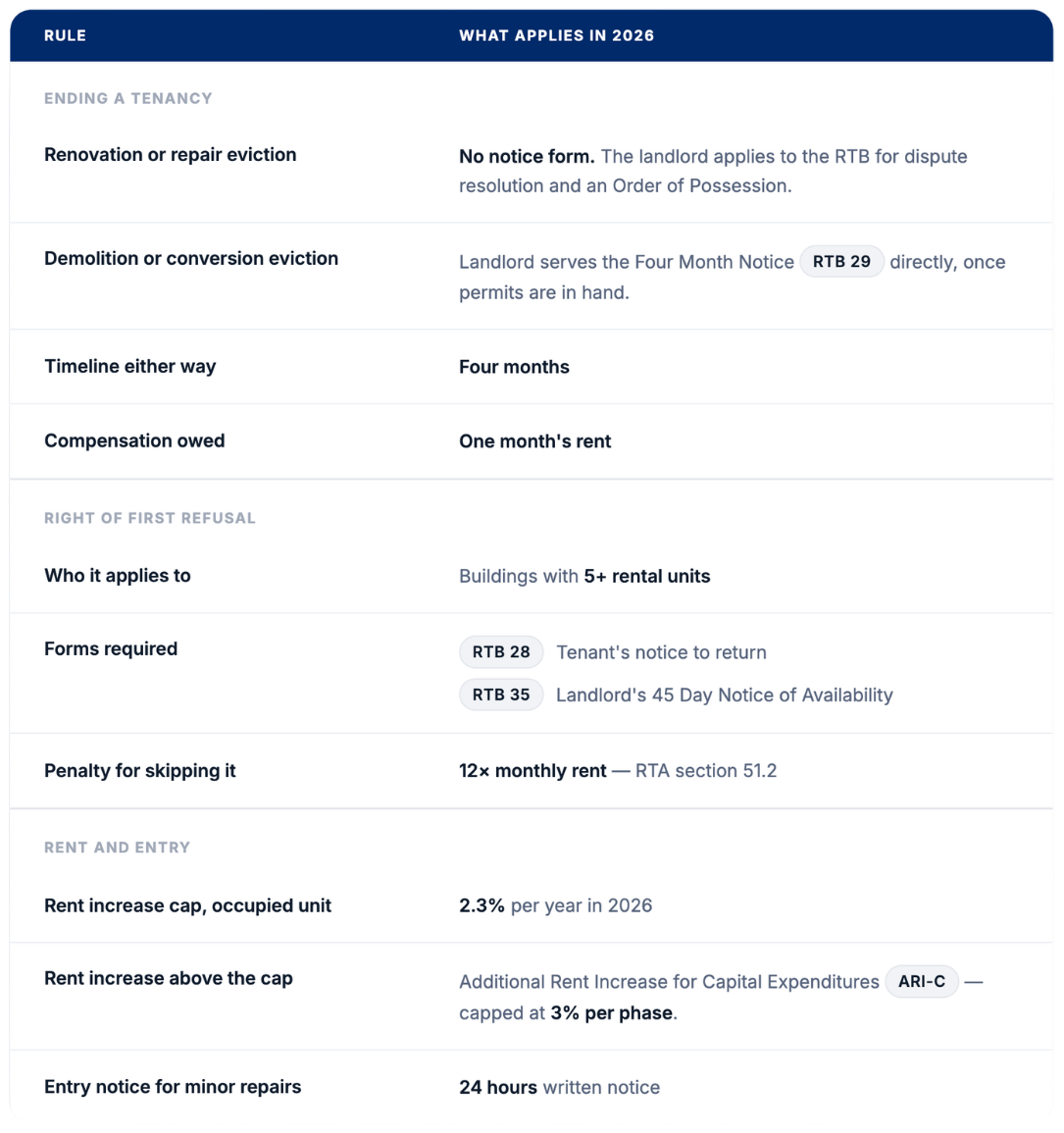
Two Different Four Month Processes
Section 49 of the Residential Tenancy Act covers more than one scenario, and BC treats them differently. Confirmed directly on the province's Types of evictions page:
- If you're demolishing the building, or converting it to strata, co-op, or non-residential use, you serve the Four Month Notice to End Tenancy for Demolition or Conversion (RTB 29) directly, once you have all required permits. The tenant then has 30 days to dispute it.
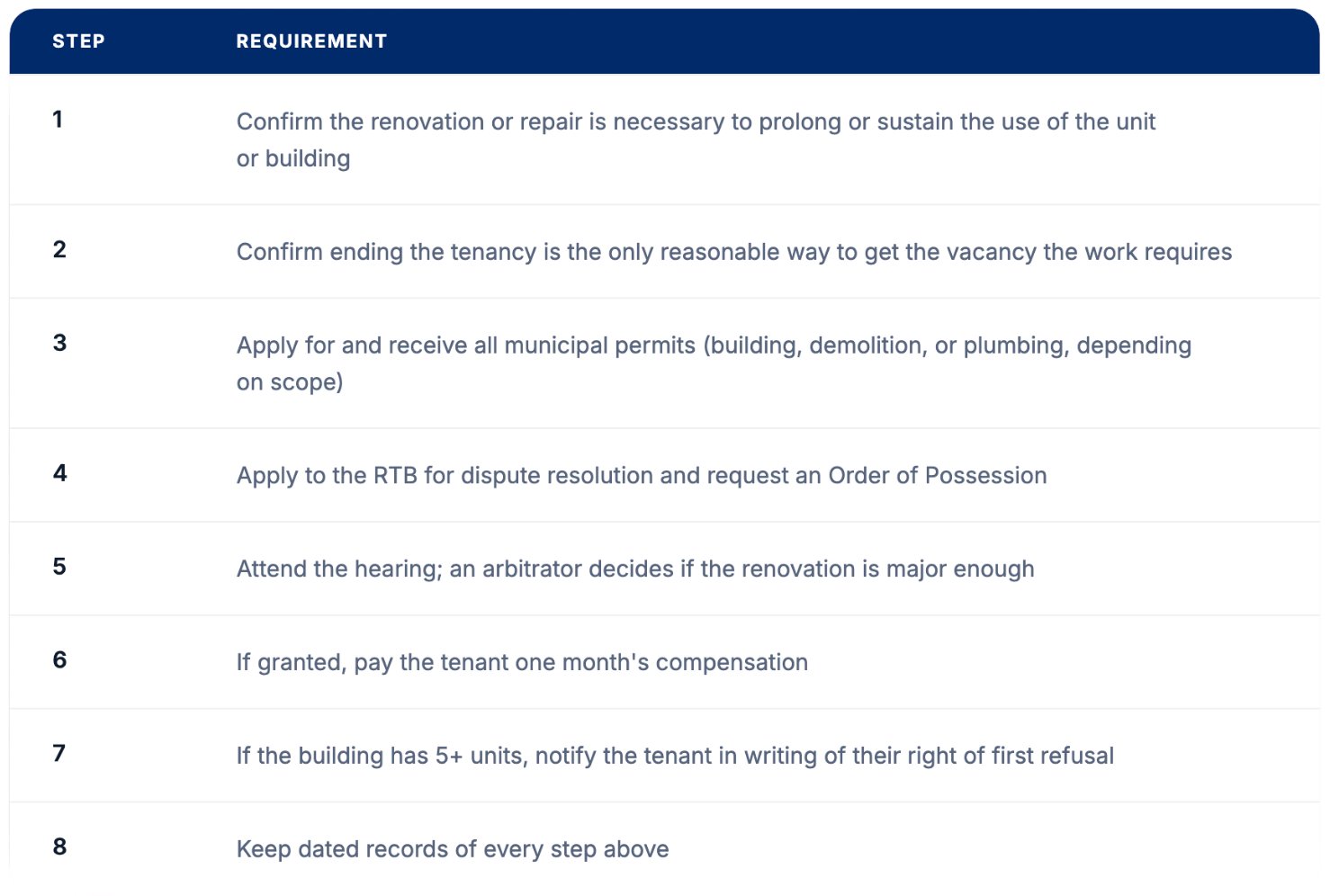
- If you're doing major renovations or repairs that require the unit to be vacant, there's no notice form. You apply to the Residential Tenancy Branch for dispute resolution and ask for an Order of Possession. An arbitrator decides whether the renovation is major enough to justify ending the tenancy, and only then do you get a four month Order of Possession.
Since renovation is what this guide is about, everything below focuses on the dispute resolution path, not the demolition path, unless noted otherwise. For the other eviction grounds that have nothing to do with renovations, unpaid rent and cause, see what the eviction process actually looks like in BC.
Do You Actually Need to End the Tenancy?
Use this quick check before you go any further:
- Does the unit need to be fully vacant for the work? If no, you just need standard 24 hour entry notice, no eviction process required.
- Do you have all required municipal permits already approved? If no, get those first. Applying before permits are in hand is one of the most common mistakes landlords make.
- Do you genuinely intend to carry out the renovation as described, and is ending the tenancy the only reasonable way to get the vacancy it requires? If the honest answer is "partly, but also to reset the rent," an arbitrator can simply refuse to grant the Order of Possession. And even if it's granted, you still have to actually complete the renovation within a reasonable period, or you owe 12 months' rent regardless of your original intent.
If you answered yes to all three, you're a candidate for the dispute resolution process below.
Before You Apply: Requirements Checklist
Right of First Refusal for Buildings With Five or More Units
If your property has five or more rental units, a tenant evicted for renovation has the right to move back into their unit at their previous rent once the work is done.
- The tenant exercises this by submitting form RTB 28.
- Before the renovation is finished, you must give the tenant a 45 Day Notice of Availability (RTB 35) along with a new tenancy agreement.
- Skipping this process, including the RTB 35 step, carries a penalty of 12 times the monthly rent under RTA section 51.3.
- A similar 12x penalty under RTA section 51 can apply if a tenant proves the stated purpose for ending the tenancy wasn't genuinely carried out.
On a $2,400 a month unit, that penalty is over $28,000. On a multi unit renovation, the exposure multiplies fast, which is why most owners loop in a paralegal before applying for an Order of Possession on anything larger than a duplex.
Can You Raise the Rent During a Renovation?
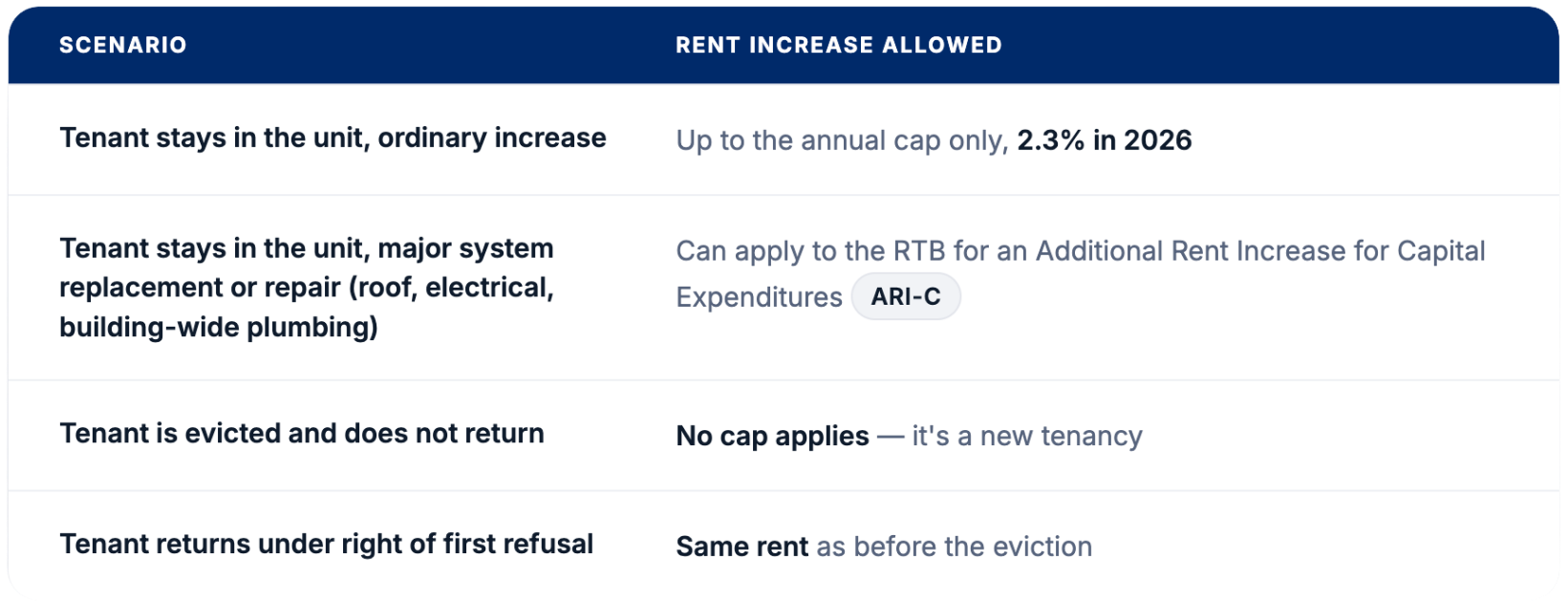
An ARI-C is capped at 3% per phase on top of the annual increase, and can roll out across up to three phases if the eligible amount is larger. The formula divides the qualifying capital cost by the number of units affected and amortizes it over 120 months, or ten years, confirmed on the province's rent increases for capital expenditures page. It requires RTB approval and documentation before you apply it, not after the fact.
For the standard annual cap and notice rules outside of a renovation, see our guide to BC's 2026 rent increase rules.
Common Mistakes That Trigger Penalties
- Assuming you can just serve a notice for a renovation the way you would for a demolition, instead of applying to the RTB for an Order of Possession
- Applying before permits are approved
- Forgetting the right of first refusal notice, or skipping the 45 Day Notice of Availability (RTB 35), on a 5+ unit building
- Renovating beyond the scope the arbitrator approved
- Raising rent above the 2.3% cap without an approved ARI-C
- Assuming Ontario style "Above Guideline Increase" rules apply in BC; BC's mechanism is the ARI-C, and the two aren't interchangeable
Renovations are just one of several RTA areas where good paperwork is the difference between a smooth process and a costly dispute. Our guide to BC landlord repair responsibilities covers the parallel rules for ordinary repairs that don't require ending a tenancy, and our checklist on what actually puts BC landlords at risk in a dispute covers the other gaps beyond renovations.
FAQ
What form does a landlord use to evict a tenant for renovations in BC?
There isn't one. Unlike a demolition or conversion, which uses the Four Month Notice (RTB 29), a renovation or repair eviction requires the landlord to apply to the Residential Tenancy Branch for dispute resolution and request an Order of Possession. An arbitrator decides if the renovation is major enough before it's granted.
How long does the renovation eviction process take in BC?
Four months either way, whether it's a demolition notice or a renovation Order of Possession, and the tenant is owed one month's compensation in both cases.
Do I need permits before I can end a tenancy for renovations?
Yes. Permits need to be in hand before you serve a demolition or conversion notice, and they're part of what you need to show the RTB before you can even apply for a renovation Order of Possession.
Can I raise the rent to cover renovation costs in BC?
If the tenant stays in the unit, you're limited to the annual increase cap, 2.3% in 2026, unless you apply to the Residential Tenancy Branch for an Additional Rent Increase for Capital Expenditures (ARI-C), which is capped at 3% per phase.
What is the right of first refusal for renovation evictions?
In buildings with five or more rental units, a tenant evicted for renovations has the right to move back into their unit at their previous rent once the work is finished, by submitting form RTB 28. The landlord must also give a 45 Day Notice of Availability (RTB 35) before the renovation is complete.
What happens if I don't offer the right of first refusal?
Twelve months' rent under RTA section 51.3, unless extenuating circumstances apply. Separately, section 51.4 requires you to actually finish the renovation the order was granted for within a reasonable period. Miss that, and you owe another 12 months' rent, since the director can only excuse it for extenuating circumstances, not simply because you acted in good faith.
Do all renovations require the tenant to move out?
No. Most repairs and upgrades can happen with the tenant in place and only require 24 hours' written notice to enter. The dispute resolution process only applies when the scope of work genuinely requires the unit to be vacant.
Can a tenant dispute a renovation eviction?
Yes. For a demolition or conversion notice, tenants have 30 days to dispute it. For a renovation, the landlord has to win an Order of Possession at a dispute resolution hearing in the first place, so the tenant's opportunity to contest it happens at that hearing.
Disclaimer: This article is general information only, not legal advice. Notice periods, penalty amounts, and rent increase caps are fact sensitive and reviewed annually. Confirm your specific situation with the Residential Tenancy Branch or a lawyer before acting.