What BC Landlords Need to Know About Rent Increases, Notice Periods, and Lease Renewals

Most landlords do not get into trouble on the big rules. They get into trouble at three specific moments: the day they decide to raise rent, the day a lease term ends, and the day they think about renewing. Each one has a rule that looks simple and is not.
Here is what actually holds up at each of those three moments in BC.
At a Glance
Before You Increase Rent
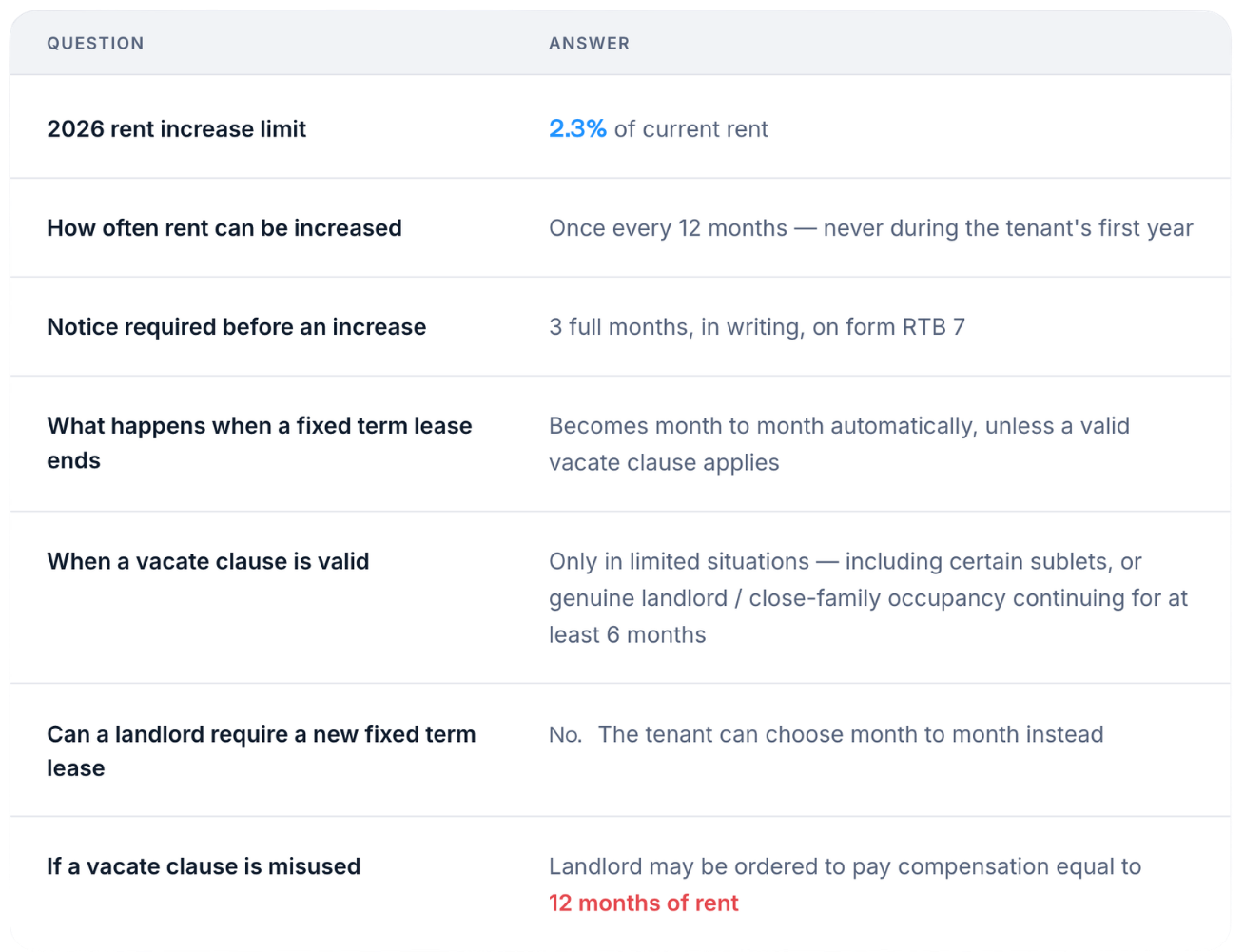
The 2026 rent increase limit is 2.3%, and it is not a number picked out of the air each fall. Under Residential Tenancy Policy Guideline 37A, the province calculates it from the average change in BC's Consumer Price Index over the 12 months ending in July of the prior year, rounded to one decimal place. That average becomes next year's limit. You can confirm the current figure directly on the Province of British Columbia's rent increases page.
Worth knowing before you plan around it. In 2023 and 2024, the province actually stepped in and capped the increase below the real CPI average, at 2 percent and 3.5 percent, when true inflation ran higher both years. 2026 is not one of those years. This year's 2.3% is the unadjusted CPI figure passed straight through, which means it moves with inflation data rather than a political ceiling.
Once you know the number, the notice is where most increases actually fail:
- Serve a written Notice of Rent Increase on form RTB 7, with the new amount and the effective date
- Give at least 3 full calendar months of notice, and land the increase on the tenant's actual rent due date
- Confirm it has been a full 12 months since the tenant's last increase
Serve the notice even a few days late and the effective date does not shift by a few days. It moves to the next date that still satisfies a full 3 months. And the cap applies to the full rent charged, so bundling in utilities or added services to justify going higher does not work either.
How to Calculate
The Math
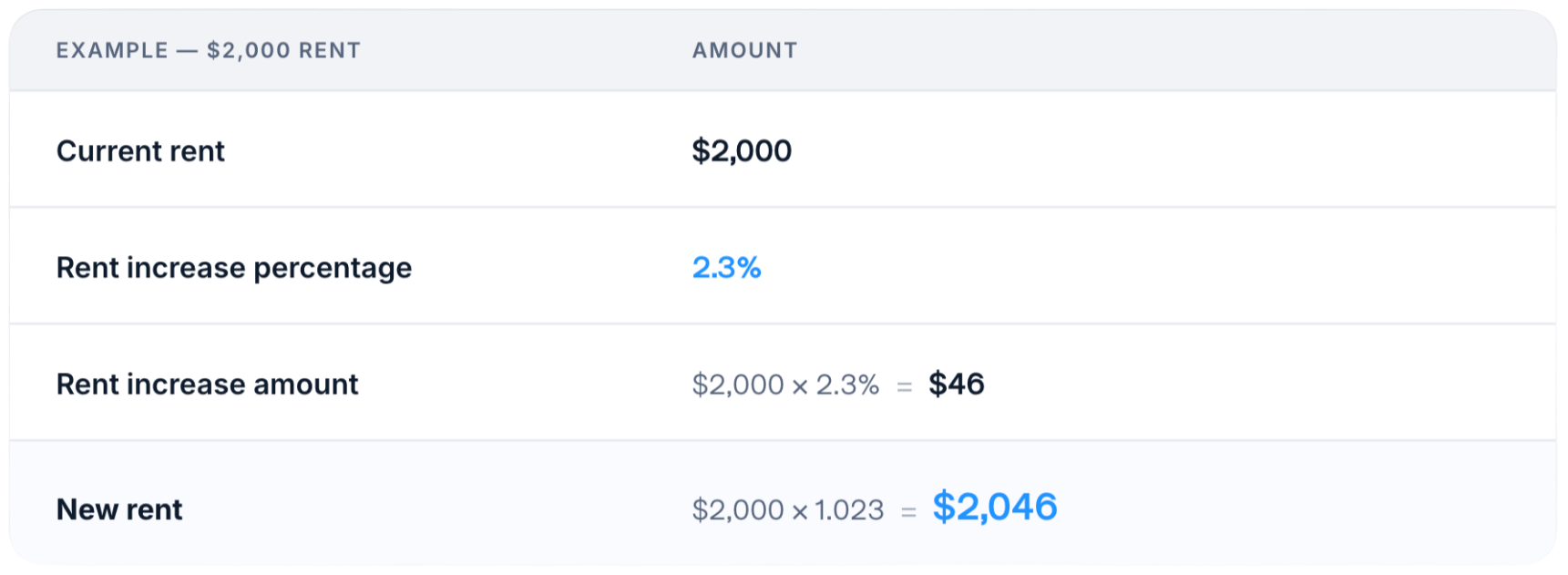
- Rent Increase Amount = Current Rent x Rent Increase Percentage
- New Rent = Current Rent x (1 + Rent Increase Percentage)
Example
When a Lease Term Ends
This is where landlords assume they have more control than they do. Reaching the end date on a fixed term lease does not end the tenancy. Under the Residential Tenancy Act, it automatically continues month to month on the same terms, including the same rent. You cannot require the tenant to move out because the term is over, and you cannot require them to sign a new fixed term agreement against their wishes.
Valid Vacate Clauses
- Certain sublets
- Cases where the landlord, or a close family member such as a spouse, parent, or child, genuinely intends to occupy the unit, and that occupancy actually continues for at least 6 months
Get this wrong and it can cost more than an unenforceable clause. If a landlord invokes this exception and does not follow through with at least 6 months of genuine occupancy, the Residential Tenancy Branch may order compensation equal to 12 months of rent. A vacate clause added to a standard lease outside these limited circumstances is not a shortcut, it is a liability.
Documenting the condition of the unit properly at this stage matters too. Our BC move-in and move-out inspections guide walks through what the Residential Tenancy Branch expects landlords to record.
Before You Renew the Lease
If both sides want another fixed term, the lease renewal itself is simple: you agree in writing and sign a new agreement. What is not simple, or legal, is using a lease renewal as a way around the annual cap. Even between two fixed term agreements with the same tenant, any rent increase between them still has to follow the same 3 month notice and 12 month timing rules above. A lease renewal is not a bigger increase in disguise.
The tenant also does not have to agree to a lease renewal at all. They can decline a new fixed term and continue month to month instead, and you cannot make continuing the tenancy conditional on signing. If a tenant decides to move out once the term ends rather than renew, they still owe you one full month of written notice, the same as ending a month to month tenancy.
If the increase you have in mind is tied to major capital work rather than the ordinary annual cap, that runs on a separate track. See our guide to BC renovation eviction rules for how the Additional Rent Increase for Capital Expenditures (ARI-C) works. And because none of these rules help if the lease terms themselves are unenforceable, our breakdown of why generic leases fail in BC, Ontario, and Alberta is worth a look before renewal.
FAQ
How much can a BC landlord raise rent in 2026?
The 2026 rent increase limit is 2.3%. This figure comes from BC's Consumer Price Index change over the 12 months ending in July 2025, as set out in Residential Tenancy Policy Guideline 37A, and the limit applies to residential tenancies covered by the Act.
How much notice do I need to give before increasing rent?
At least 3 full months of written notice on form RTB 7. Rent can only be increased once every 12 months, and never during the tenant's first year in the unit.
Does a fixed term lease end automatically when the term is up?
No. Unless the agreement includes a valid vacate clause, the tenancy automatically continues month to month on the same terms once the fixed term ends. You cannot require the tenant to move out or sign a new lease.
When is a vacate clause actually enforceable?
Only in limited circumstances, including certain sublets or when the landlord or a close family member genuinely intends to occupy the unit, and that occupancy actually continues for at least 6 months.
Can I use a new lease renewal to raise rent above the yearly cap?
No. Even between two fixed term agreements with the same tenant, any rent increase still has to follow the standard notice and timing rules.
Do I need to use form RTB 7 to raise rent in BC?
Yes. The Notice of Rent Increase, form RTB 7, is the only form the Residential Tenancy Branch accepts for a rent increase. A letter, email, or verbal notice on its own does not satisfy the legal notice requirement, regardless of how much notice it gives.
Can a landlord force a tenant to sign a new lease at renewal?
No. At the end of a fixed term, the tenant can choose to sign a new fixed term lease or continue on a month to month tenancy instead. A landlord cannot make continuing the tenancy conditional on signing a new lease.
What happens if a landlord does not renew a lease in BC?
Nothing changes for the tenant. If the landlord does not offer a lease renewal, or the tenant does not want one, the tenancy simply continues month to month on the same terms. The tenant does not need to move out or agree to anything to stay.
What happens if I include an invalid vacate clause and the tenant has to leave anyway?
If a landlord invokes the vacate clause exception and does not follow through with at least 6 months of genuine occupancy, the Residential Tenancy Branch may order compensation equal to 12 months of rent.
Disclaimer: This article is general information only, not legal advice. Rent increase percentages, notice timelines, and lease renewal rules are fact sensitive. Confirm your specific situation with the Residential Tenancy Branch or a lawyer before acting.
THE AUTHOR

Related Articles








Sign up during early access and get free concierge listing service.
We'll handle your first listing end-to-end — professional photography, a 3D Matterport tour, optimized listing copy, and syndication across rental platforms. A $400+ value, free for early access landlords.
The Wait Is
Almost Over
Everything you can do on the web — listings, screening, leases, payments — in your pocket. Sign up now and be the first to know when the app drops.
Available Soon on App Store & Google Play