

An extra $300 a month in rent can leave you barely ahead. In this guide's worked example, a unit rents for $2,200 unfurnished or $2,500 furnished. After allowing for vacancy and the cost of the furniture, furnishing adds just $4.67 per average month.
The example assumes nine-month furnished stays, one empty month between tenants and an $8,000 furniture package lasting five years. Change those assumptions and the answer changes. Here is how to calculate the premium your own unit needs.
What this comparison measures
It compares two ways of offering the same vacant unit: unfurnished, or furnished. It is a simplified, pre-tax comparison of average monthly income, not a forecast of market rent, total property profit or how quickly you recover the furniture spend. It doesn't apply to raising an existing tenant's rent.
The base case assumes a repeating occupancy cycle, constant rents and costs, rent collected as due, no resale value for the furniture, and no financing or return-on-capital charge. If you plan to sell or change how you use the unit before the furniture wears out, this simple average isn't enough for that decision.
The break-even formula
In plain terms: work out the unfurnished income you are giving up, add the extra furnished costs, then allow for the months the furnished unit is empty.
Break-even furnished rent = (U + F) × (S + G) ÷ S
- U: unfurnished income per calendar month after vacancy and turnover costs: (unfurnished rent × occupied months − cost per turnover) ÷ (occupied months + empty months)
- F: extra monthly cost of the furnished option: the furniture allowance (furniture spend ÷ months it will last), plus furnished turnover costs averaged over the furnished cycle, plus any recurring costs the unfurnished option doesn't carry, such as utilities or internet you include
- S: expected occupied months per furnished tenancy
- G: expected empty months between furnished tenancies
Furnished rental premium needed = break-even furnished rent − unfurnished rent.
Count each cost once, and only if it differs between the two options. An appliance or window covering supplied either way is not a furnishing cost. If you want to account for your own time, assign it a value and include it once in the turnover estimate.
Worked example: a $2,200 one-bedroom
Illustrative inputs. Swap in your own.
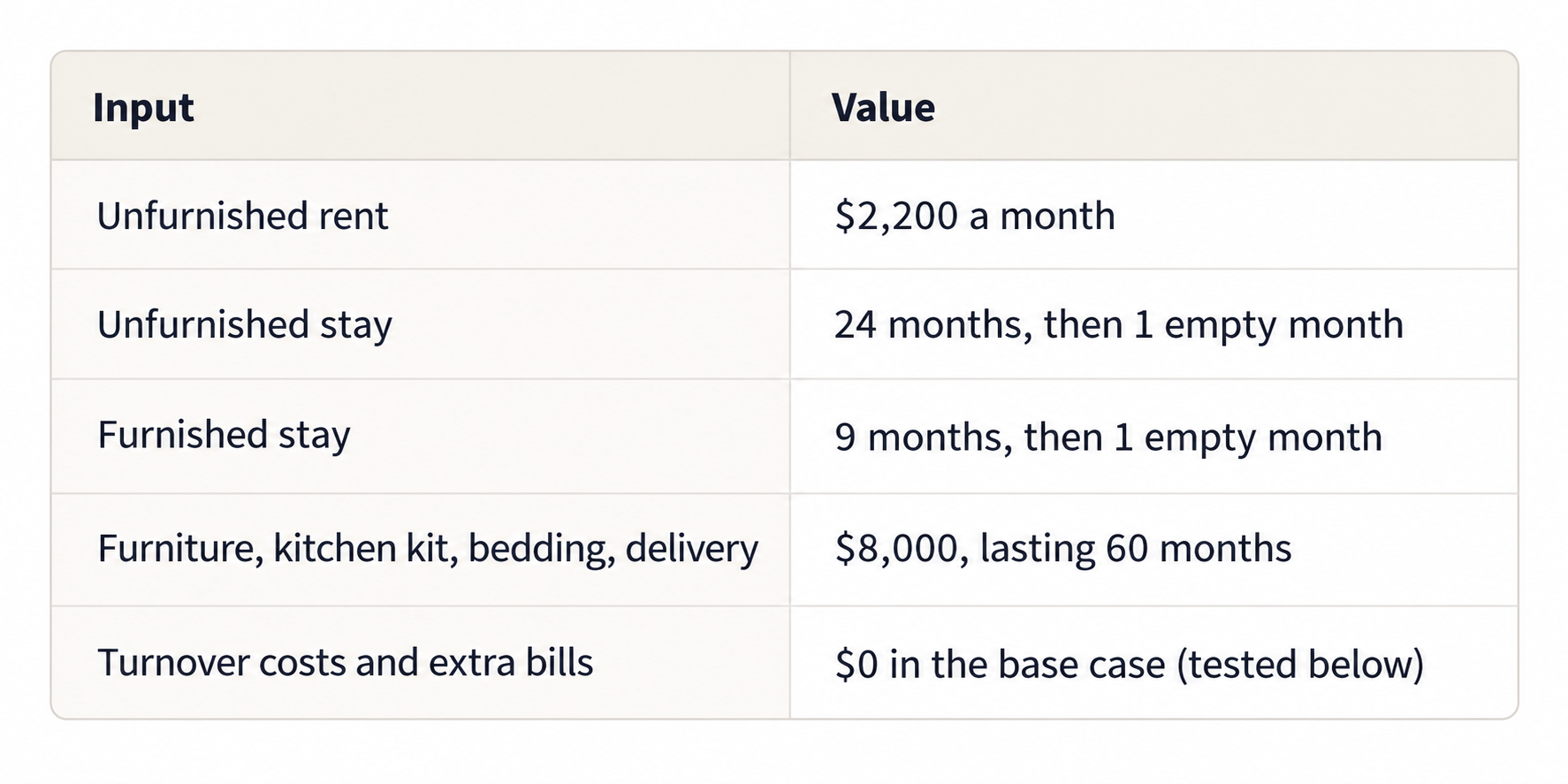
- U = $2,200 × 24 ÷ 25 = $2,112
- F = $8,000 ÷ 60 = $133.33
- Break-even furnished rent = ($2,112 + $133.33) × 10 ÷ 9 = $2,494.81
- Premium needed = $2,494.81 − $2,200 = about $295 a month
At $2,500 furnished, the unit averages $2,500 × 9 ÷ 10 − $133.33 = $2,116.67 a month, only $4.67 above unfurnished.
The $133.33 is an allowance for using up the furniture over five years. It isn't a monthly bill or a tax deduction, and the $8,000 still has to be paid up front.
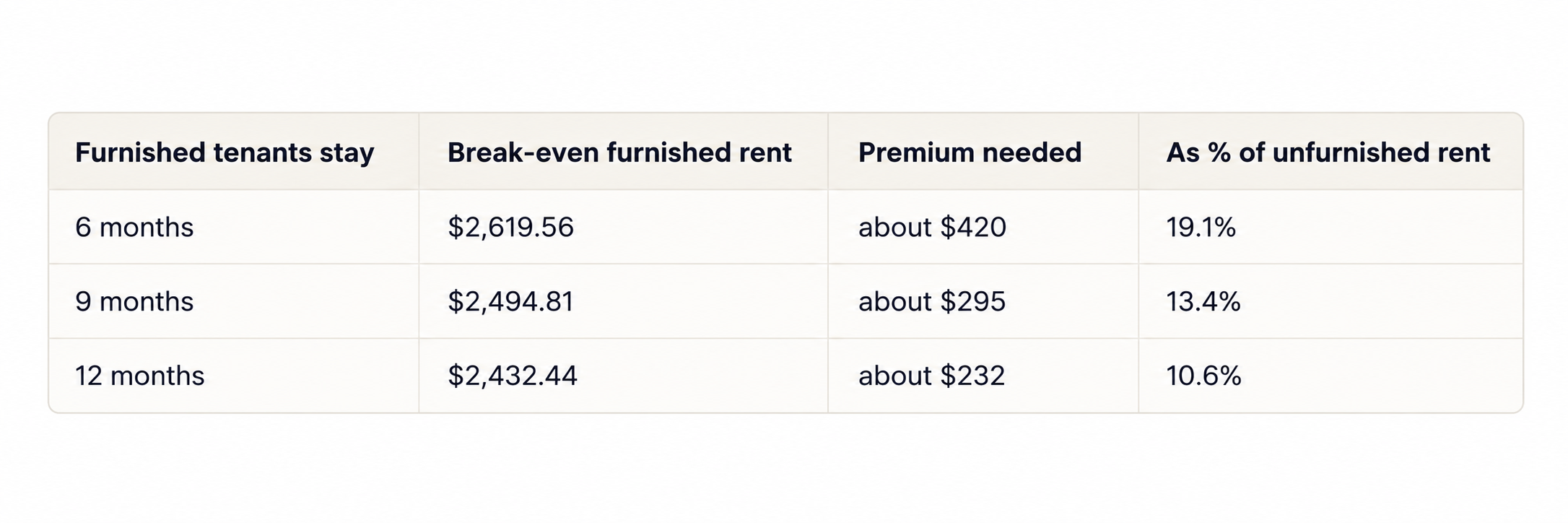
What changes the answer
Each row changes one input in the nine-month example and leaves the rest at the base case. Test stay length, vacancy and costs separately; which one matters most depends on your numbers.
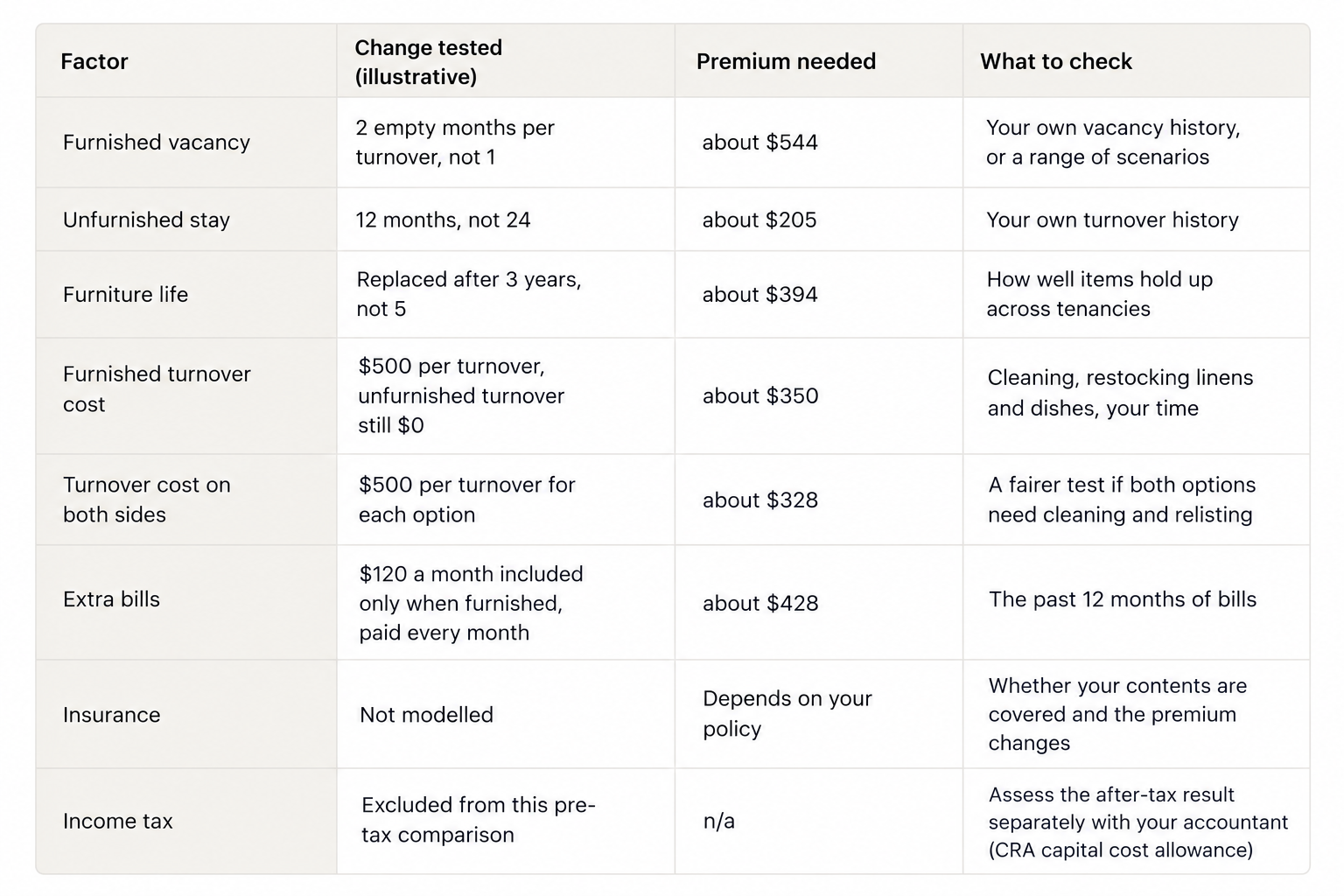
If you are considering shorter stays, check the provincial, municipal and strata requirements for the stays you intend to offer. Short-term rental definitions vary. In BC, for example, the provincial definition generally covers stays of fewer than 90 consecutive days (BC short-term rental guidance).
Checking local offers
The formula gives you a threshold. Comparable listings show the offers you compete with; they don't confirm the rent a signed lease achieves.
- Compare like with like. Use furnished and unfurnished listings in the same neighbourhood, with comparable property type, size, condition and inclusions, rather than a city average. Rentals.ca's methodology excludes identifiable furnished suites, so its averages aren't a furnished benchmark. Our guide to why Canadian rent reports disagree covers how sources differ.
- Adjust for utilities, incentives and terms. A listing offering a free month is asking less than its headline rent. Our guide to move-in incentives versus lower rent shows how to work out effective rent.
- Don't read stay length from ads. Advertised lease terms aren't the same as how long tenants actually stay, and days advertised aren't the same as days vacant. In BC, for example, most fixed-term tenancies continue month to month at the end of the term (BC tenancy guidance). Use your own tenancy history where you have it, and a range of scenarios where you don't.
If you do furnish
- List exactly what's included, item by item, alongside the rent and terms.
- Photograph the actual setup in every room.
- Document its condition in an itemized inventory, walk through it with the tenant at move-in, and attach it to the tenancy agreement.
The decision
Compare a conservative furnished rent estimate, after incentives, with your calculated threshold. If it falls below the threshold, furnishing doesn't earn more under those assumptions. If it only just clears the threshold, test a longer vacancy, earlier replacement or higher turnover cost before buying. A few dollars of modelled advantage gives you little room for error.
FAQ
Does this calculation tell me when I recover my furniture spend?
No. It compares average monthly income using a furniture-life allowance. Knowing when the upfront $8,000 is paid back needs a separate cash-flow calculation.
Is a partly furnished unit a good middle ground?
It can be. Count only the items you would add, such as a bed, sofa or dining set, not appliances or window coverings you'd supply either way. A smaller furniture spend lowers F and the premium you need, so run the formula for both versions.
Can I use this to justify raising a current tenant's rent?
No. It compares two ways of offering a vacant unit. Rent increases for existing tenants follow separate rules.