
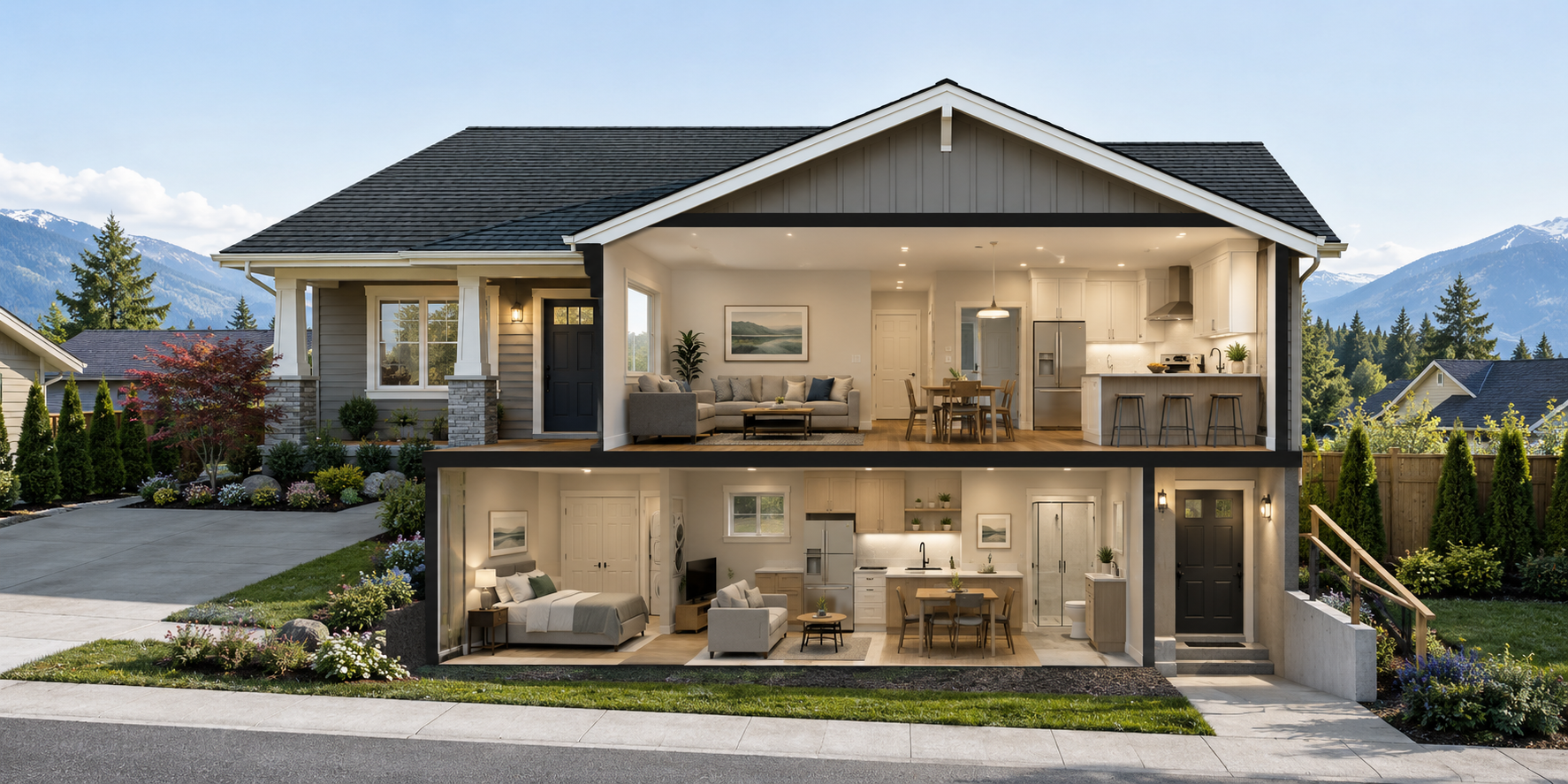
Most guides about secondary suites are written for one of two people: someone deciding whether to build a suite, or a realtor flagging suite status before a sale. If you already have a finished basement and you're trying to decide whether you can hand a tenant the keys next month, neither of those really answers your question.
This is that checklist. Not "should I build a suite," but "is the one I already have legal to rent out, and what happens if it isn't."
Key Takeaways
- A legal secondary suite in BC has to clear three separate layers: provincial building code, municipal zoning, and your municipality's registration or business license process. Missing any one of them can make the suite illegal to rent, even if the other two check out.
- Renting an unregistered suite doesn't get you out of the Residential Tenancy Act. You still owe your tenant a proper notice, a proper deposit process, and proper repairs, since the RTA applies whether or not city hall knows the suite exists.
- Homeowners insurance is the risk landlords underestimate most. If a fire or flood starts in an undisclosed suite, insurers can and do deny the claim, which means you're personally on the hook for tenant losses and property damage.
The Checklist
- Your municipality allows a suite on this lot
- The suite meets BC Building Code minimums
- The suite is registered or licensed with your city
- Parking meets your municipal bylaw
- Your insurance provider knows the suite exists
- You've accepted that the RTA applies either way
1. Your Municipality Allows a Suite on This Lot
Start here, not with the tape measure. Since BC's Small-Scale Multi-Unit Housing legislation (Bill 44, 2023) and the follow-up Bill 25 in 2025, nearly every municipality in the province has to permit a secondary suite on single-family and duplex lots. Every municipality over 5,000 people had to update its zoning bylaws by June 30, 2024, and a further round of updates is due by June 30, 2026 under Bill 25.
In practice that means most single-family lots in Vancouver, Burnaby, Surrey, and similar cities are zoned to allow a suite today. But "most" isn't "all," and zoning still varies by lot type, heritage designation, and sometimes by specific neighborhood plan. A suite that was legal under an older bylaw can also fall out of compliance if the city changed size or setback rules since it was built. Before you list the unit, check your specific address against your current municipal zoning bylaw, not a general summary of what the province requires.
2. The Suite Meets BC Building Code Minimums
This is where most older, informally finished basements fail, usually on more than one point. The BC Building Code sets specific minimums for a secondary suite, and inspectors check for all of them, not just the obvious ones:
- Ceiling height: minimum 1.95 m (about 6'5") across the suite, generally required over at least 75% of the floor area.
- Egress: every bedroom needs a window or door that opens directly to the outside, sized to code, so someone can get out, or be reached by a firefighter, without going through the rest of the house.
- Fire separation: typically a minimum 30 to 45 minute fire-rated separation between the suite and the rest of the house, with some municipalities requiring a full one-hour separation.
- Smoke alarms: hardwired, interconnected smoke alarms in both the suite and the main house, so one alarm triggers both. If there's a fuel-fired appliance or an attached garage, add a carbon monoxide alarm within 5 m of the bedrooms.
- A self-contained unit: its own kitchen, its own bathroom, its own entrance separate from the main house's entrance.
If your suite is missing hardwired interconnection between the two units' smoke alarms, or the basement ceiling sits at 6'2" instead of 6'5", it's not legal to rent as-is, regardless of how nice the renovation looks. These are pass or fail items on an inspection, not suggestions.
3. The Suite Is Registered or Licensed With Your City
Meeting the building code is necessary, but it isn't the same as being on file with your municipality. Most cities require either a secondary suite registration, a rental business license, or both, and the process, requirements, and fees vary by city, so confirm the current details for your address directly with your municipality rather than relying on a neighboring city's numbers.
In Burnaby, for example, a secondary suite has to sit in an eligible zone, currently R1, A1, A2, A3, or RM6 per the city's Secondary Suite Program page, and the owner needs a business license to rent it out, separate from confirming zoning. Burnaby updated its business license fee schedule for 2026, so check the current fee on the city's business licence page before budgeting for it. Vancouver takes a different approach: its own secondary suite guide requires the suite to be smaller than the main part of the house (commonly applied as a cap of roughly 35% of the principal dwelling's floor area, up to about 90 m²) and, notably, holds suites to a stricter ceiling height than the general provincial minimum, at least 1.98 m (6'6") in exit routes and across 80% of the suite, verified through its own permit and inspection process.
If your suite was finished without a permit, this is the step to deal with before you list it, not after a tenant moves in. Retrofitting for compliance after the fact, adding a fire-rated ceiling, swapping a window for a proper egress opening, is a renovation project with a tenant already living downstairs, which is a much worse position to be in than doing it with the unit empty. If you're weighing whether to fix the suite before or after someone moves in, it's worth understanding how BC's renovation eviction rules work first, since displacing an existing tenant to bring a suite up to code triggers its own notice and compensation requirements under the RTA.
4. Parking Meets Your Municipal Bylaw
Parking gets overlooked because it feels minor next to fire separation and egress windows, but it's a real compliance point that shows up on suite registration applications. Most municipalities, including Burnaby, Vancouver, and Surrey, require additional off-street parking once a secondary suite is added, though the exact number of stalls, and any exceptions near frequent transit, vary by zone and by city. If your suite registration gets held up, a missing or undersized parking stall is a common, fixable reason why. Check your specific zoning schedule, or ask your municipality's planning department, before assuming your existing driveway or pad automatically qualifies.
5. Your Insurance Provider Knows the Suite Exists
This is the item that costs landlords the most money when it goes wrong, and it's the one that never comes up until there's already a fire, a flood, or a liability claim.
Standard homeowners insurance is written for an owner-occupied single-family home. The moment you add a rented, self-contained suite, you've changed the risk profile of the property, and most policies require you to disclose that. If you don't, and something happens, a kitchen fire in the suite, a burst pipe, a tenant's guest getting injured on the stairs, insurers can deny the claim specifically because the rental unit wasn't disclosed. At that point you're covering tenant losses, repair costs, and possibly a liability claim out of pocket, on top of whatever the original damage cost.
Call your insurer before you list the suite, not after you sign a lease. Ask directly whether your current policy covers a secondary suite tenancy, and get it in writing if the answer is yes. If it isn't covered, you'll typically need a landlord or rental dwelling policy, which costs more than standard homeowners coverage but is far cheaper than an uninsured claim.
6. You've Accepted That the RTA Applies Either Way
Here's the part that surprises landlords who've been putting off registration: renting an unregistered or non-compliant suite doesn't exempt you from BC's Residential Tenancy Act. Whether or not your municipality knows the suite exists, you and your tenant are both still bound by the RTA: proper notice periods, proper deposit handling, and your repair obligations under the Act all still apply. An unregistered suite doesn't buy you a lighter version of landlord obligations. It just adds a second, separate risk on top of the normal tenancy risk: if the city discovers the suite, it can order it shut down, which can also trigger a One Month Notice to End Tenancy under section 47(1)(k) of the RTA, meaning your tenant gets displaced through no fault of their own, and you're dealing with both a bylaw problem and a tenancy problem at the same time.
If you're not confident on where your baseline repair and notice obligations stand regardless of suite status, it's worth reviewing what the RTA actually requires landlords to repair and what puts BC landlords at risk in a dispute before you list the unit.
How Property Copilot Helps
None of the six items above are things a listing tool can verify for you. Zoning, building code compliance, and insurance disclosure are on the landlord, and they need to be sorted before the unit goes live. But once the suite is legal to rent, everything downstream of that is where Property Copilot earns its keep.
Screening runs ID verification on every applicant by default, with Equifax-powered credit checks available before you approve anyone, useful for any unit, but especially one where you've just invested in bringing it up to code and want a tenant who'll take care of it.
Listings go out with accurate unit details from day one, so a suite's actual layout, entrance, and parking situation are represented correctly instead of glossed over.
Leasing runs through BC-specific lease templates with e-signatures built in, so the suite's terms (rent, what's included, parking, shared spaces if any) are documented in the signed agreement instead of a verbal understanding that's hard to enforce later.
Getting the suite compliant is on you. Once it is, we handle the part where you turn a compliant unit into a documented, defensible tenancy.
FAQ
Is it illegal to rent out a basement suite in BC?
Not automatically, but it can be. A basement suite is legal to rent only when it clears three separate requirements: it's allowed under your municipal zoning, it meets BC Building Code minimums for things like ceiling height, egress, and fire separation, and it's registered or licensed with your city where that's required. A suite that's missing any one of the three isn't legal to rent, even if it looks finished and livable.
Can I still be sued or fined if my tenant knew the suite wasn't registered?
Yes. A tenant's awareness of the suite's status doesn't change your obligations under the Residential Tenancy Act or your municipality's bylaws. The RTA applies to the tenancy regardless of what either party knew going in, and a municipality can still act on an unregistered suite it discovers, independent of what the tenant agreed to.
Does my home insurance automatically cover a secondary suite?
Usually not. Standard homeowner policies are written for owner-occupied properties, and adding a rented suite changes the property's risk profile enough that most insurers require disclosure. If a claim comes in and the insurer finds an undisclosed rental unit involved, they can deny it. Confirm directly with your provider before renting the suite out, not after.
What happens if the city finds out my suite is illegal after I've already rented it out?
The city can order the suite to stop being used as a rental, and in some cases require it be brought back to single-family use. That can also count as grounds for a One Month Notice to End Tenancy under section 47(1)(k) of the RTA, which displaces your tenant and puts you back at square one on both compliance and re-renting the unit.
Do all BC municipalities require the same secondary suite rules?
No. The provincial Building Code minimums are consistent everywhere, but zoning permissions, registration processes, business license fees, and parking requirements are all set at the municipal level and vary by city. Always confirm your specific city's current bylaw rather than relying on a neighboring municipality's rules.
Disclaimer: This article is general information, not legal or construction advice. Secondary suite requirements are set at both the provincial and municipal level and change over time. Confirm your specific zoning, building code, and licensing requirements with your municipality's building department before renting out a suite.