
Guarantors and Cosigners: When BC Landlords Should Ask for One

Table of Contents
- What Is a Guarantor, and How Is It Different From a Cosigner
- Why the Distinction Actually Matters Under BC Law
- When You Should Ask for a Guarantor or Cosigner
- How to Screen a Guarantor Properly (Step by Step)
- What a Guarantor Agreement Needs to Hold Up
- Common Mistakes BC Landlords Make With Guarantors
- Where Property Copilot Helps
- FAQ
TL;DR
A guarantor promises to cover unpaid rent or damage only after the tenant has already failed to pay, and stays outside the tenancy itself. A cosigner signs the lease alongside the tenant and is equally on the hook from day one, which under BC's Residential Tenancy Act makes them a co-tenant with full tenant rights. That difference is exactly why an unscreened, poorly worded agreement can leave you with a promise you can't actually collect on. Ask for a guarantor or cosigner when income, credit, or rental history falls just short of your bar, run the same screening you'd run on any applicant, get written consent for credit checks under BC's Personal Information Protection Act, and put the agreement in writing with clear, joint terms that match the lease.
At a Glance
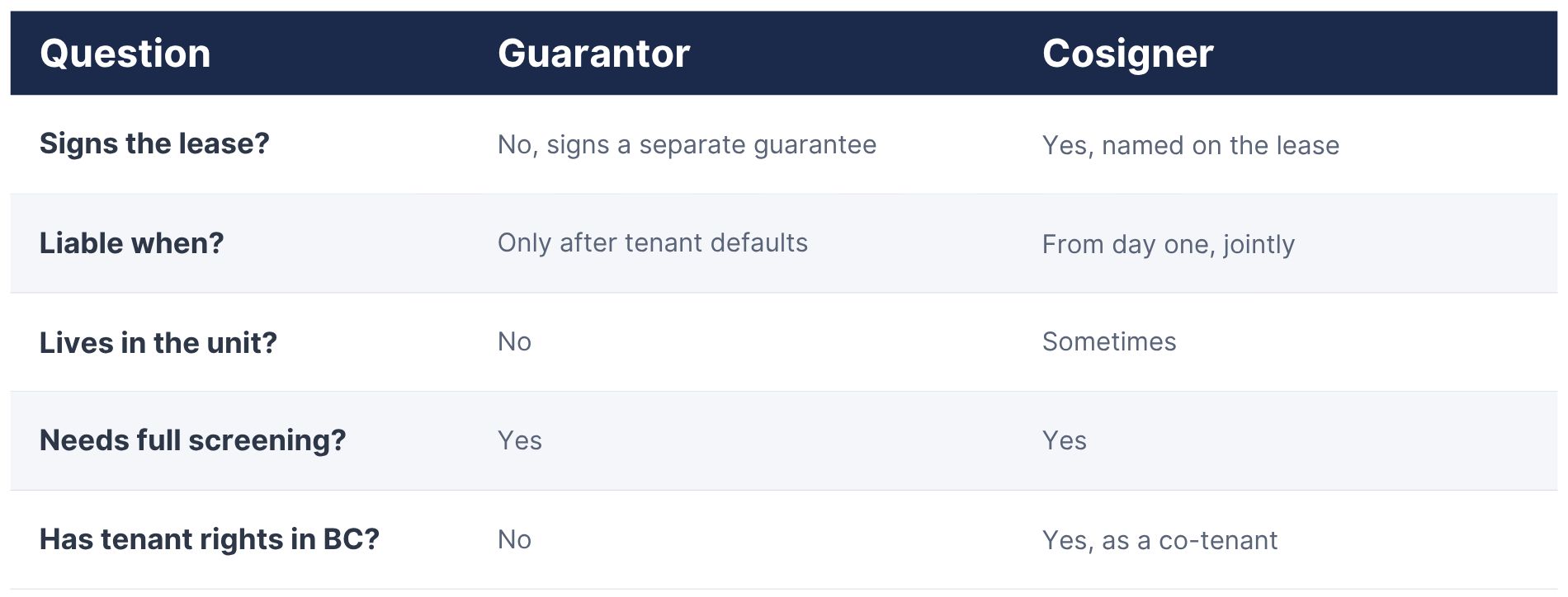
What Is a Guarantor, and How Is It Different From a Cosigner
The two words get used interchangeably online, and that's part of why the existing content on this topic is so unhelpful. They are not the same commitment, and the difference changes what you can enforce.
A guarantor is a third party, typically a parent, relative, or close friend, who signs a separate guarantee agreement promising to cover rent or damage if the tenant doesn't. Their liability is secondary: you generally have to show the tenant defaulted first before you can pursue the guarantor. A guarantor is not a tenant, doesn't sign the lease, and has no right to occupy the unit.
A cosigner signs the lease alongside the tenant and takes on equal, immediate responsibility. If rent is late, you can pursue the cosigner directly, without first proving the primary tenant failed to pay. Because a cosigner is named on the lease, they're legally a co-tenant, which means they also pick up tenant rights and, in some cases, the right to occupy the unit.
Why the Distinction Actually Matters Under BC Law
British Columbia's Residential Tenancy Act (RTA) governs the relationship between landlords and tenants, and it doesn't have a defined category for "guarantor." That has two practical consequences.
A guarantor can't use the Residential Tenancy Branch (RTB). Because a guarantor never becomes a party to the tenancy agreement, they can't file a dispute resolution application with the RTB, and you generally can't get an order against them through the RTB either. If a guarantor doesn't pay after a tenant defaults, enforcing that promise usually means a separate civil claim (often in Small Claims Court for amounts under the provincial limit), based on the guarantee contract itself, not the RTA.
A cosigner is a co-tenant, full stop. Because they signed the lease, a cosigner has the same rights and exposure as any other tenant named on the agreement, including the ability to file with the RTB and the same notice protections. If you want someone financially attached to the tenancy without giving them occupancy rights, a guarantor, not a cosigner, is the right structure.
This is also why the guarantee agreement needs to be its own clearly worded document, separate from the lease. If a guarantor's promise is vague, undated, or bundled loosely into the lease itself, you may find it difficult to enforce as a standalone contract when you actually need it.
When You Should Ask for a Guarantor or Cosigner
Requiring a guarantor for every application slows down leasing and can steer strong tenants toward a competing listing. Reserve it for applications that fall just short of your standard, not applications you'd reject outright anyway. Common triggers worth building into your pre-qualification criteria:
- Income below your guideline. Many landlords use a rough benchmark of 2.5 to 3 times monthly rent in gross income; if an applicant lands meaningfully below that, a guarantor covering the gap is often a better outcome than a flat rejection. Treat this as a guideline you weigh alongside references and credit, not an automatic cutoff. BC's Human Rights Code protects lawful source of income, so a rigid income test risks screening out applicants on assistance, disability benefits, or a pension who would otherwise qualify.
- No Canadian credit or rental history. Newcomers, international students, and first-time renters frequently have thin or nonexistent credit files here, even with strong income and a clean history abroad. A guarantor with an established Canadian credit profile bridges that gap.
- Credit score below your cutoff. A score in the 600s with an otherwise solid application (stable job, good references) is a reasonable case for a guarantor rather than an automatic decline.
- Self-employed or variable income. Income verification is harder when there's no employer to call, and a guarantor adds a second, more easily verified income source.
- Students without independent income. This is the classic case, and it's usually a parent stepping in as guarantor.
What it shouldn't be used for: papering over red flags like a past eviction, falsified documents, or a background check that raises real tenancy risk. A guarantor reduces financial risk. It doesn't offset conduct risk.
How to Screen a Guarantor Properly (Step by Step)
This is the step landlords skip most often, and it's the one that determines whether the guarantee is worth anything. A guarantor who hasn't been screened is just a name on a form.
- Require a full application from the guarantor, not just a signature. Have them complete the same rental application form your tenant filled out: identification, current address, employment, and contact details.
- Get written consent before pulling credit. Under BC's Personal Information Protection Act (PIPA), you need the individual's knowledge and consent before collecting or checking their credit, just as you would for the tenant. Use a separate consent form for the guarantor; don't assume the tenant's consent covers a third party.
- Verify income at a higher bar than the tenant. Because a guarantor isn't living in the unit and is only a backstop, many landlords look for meaningfully higher income relative to rent, often cited around 4 to 5 times the monthly rent in gross income, since that single income now has to cover their own obligations plus the tenant's rent if needed. Use this as a starting benchmark rather than a fixed pass or fail line, and confirm it against your own pre-qualification criteria before applying it consistently.
- Pull a full credit report, not just a score. Look for existing debt obligations, other guarantees they may have already signed, and any collections history. A guarantor with their own high debt load may not actually be in a position to cover your tenant's rent.
- Confirm Canadian residency and reachability. A guarantor who lives outside Canada or is difficult to serve notice to is much harder to pursue if you ever need to. Most landlords require the guarantor to reside in Canada.
- Verify identity with government-issued ID. Confirm the person signing the guarantee is who they claim to be, matched against the application.
- Document everything the same way you would for the tenant. Keep copies of the consent form, credit report, income verification, and signed guarantee in the same file as the tenancy agreement.
What a Guarantor Agreement Needs to Hold Up
A verbal promise or a one-line addition to the lease ("[Name] guarantees this tenancy") is not a guarantee agreement, it's a gap waiting to be found in a dispute. A properly drafted guarantor agreement should include:
- Full legal names of the guarantor, tenant, and landlord, and a clear statement that the guarantor's obligation is triggered by the tenant's default.
- A term that matches the tenancy. If the guarantee expires before the lease does, or before a renewal, you've created a gap in coverage.
- The scope of what's guaranteed: unpaid rent, damage beyond normal wear and tear, and any other costs you want covered, spelled out rather than implied.
- A separate signature and date, independent of the lease signature page, so the guarantee reads as its own enforceable contract.
- Notice provisions describing how and when you'll notify the guarantor of a default, and within what timeframe they need to respond.
Because this document sits outside the RTA, it's worth having a paralegal or lawyer review your template once, even if you build most tenancy documents yourself. A guarantee agreement is closer to a commercial contract than a residential tenancy form, and small wording gaps are what get exploited if it's ever tested in Small Claims Court.
Common Mistakes BC Landlords Make With Guarantors
- Treating the guarantor's signature as enough, without screening. If you wouldn't rent to them, don't accept them as a backstop either.
- Treating the income ratio as an automatic cutoff. Because lawful source of income is protected under BC's Human Rights Code, screening out a guarantor purely because their income comes from disability benefits, income assistance, or a pension, without assessing whether it actually covers the obligation, carries real risk. Use the ratio as one input alongside references and credit, not a bright line.
- Letting a guarantor move into the unit. The moment a guarantor is living in the rental, courts and the RTB may treat them as a de facto tenant, which changes their rights and your ability to enforce the original agreement as written.
- Skipping the separate consent form. Running a credit check on a guarantor without their own documented consent is a PIPA compliance gap, not just a paperwork nicety.
- Assuming the RTB can enforce a guarantor's promise. It generally can't. Plan for civil enforcement from the start rather than discovering the limitation after a tenant has already defaulted.
- Not renewing the guarantee at lease renewal. If the tenancy rolls into a new fixed term or month-to-month period, confirm the guarantee agreement's language actually covers that continuation.
Where Property Copilot Helps
The decision to ask for a guarantor shouldn't be a gut call made mid-application, but it doesn't need to be a formal system either. Know ahead of time what income, credit, and rental history you're comfortable accepting on their own, so you can spot a borderline application quickly and have your guarantor application, consent forms, and guarantee template ready to go rather than pulling them together on the fly.
If you're screening manually across several units, this is exactly where things slip: the guarantor's application gets a lighter check than the tenant's, or the consent form never gets signed because it's a separate step outside your normal process. Property Copilot's tenant screening tools run the same credit, income, and background checks on every applicant on a file, guarantor included, so the extra signature on your lease is actually backed by a verified promise.
For the screening steps that come before this stage, see our guides on tenant credit checks in Canada and how to screen tenants in BC without breaking the law. For the legal backdrop, the province's own overview of residential tenancy dispute resolution is a useful reference, and TRAC's tenant resource on applying for dispute resolution is worth bookmarking if a dispute does end up in front of the RTB.
FAQ
Can a landlord require a guarantor in BC?
Yes. There's no provision in the Residential Tenancy Act that prohibits requiring a guarantor, and it's a common condition when an applicant's income or credit falls short of a landlord's standard requirements. The guarantee itself is a separate contract, outside the RTA.
What's the difference between a guarantor and a cosigner?
A cosigner signs the lease and is jointly, immediately liable for rent from day one. A guarantor signs a separate agreement and is only liable after the tenant has already defaulted. A cosigner becomes a co-tenant with tenant rights; a guarantor does not.
Does a guarantor need to pass a credit check?
Yes, and skipping this step is one of the most common mistakes landlords make. Screen the guarantor's credit and income at least as thoroughly as the tenant's, and get their written consent first, since BC's Personal Information Protection Act requires consent for that collection just as it does for the tenant.
Can the Residential Tenancy Branch enforce a guarantor's promise?
Generally, no. A guarantor isn't a party to the tenancy agreement, so the RTB doesn't have jurisdiction over the guarantee itself. Enforcing an unpaid guarantee typically means a separate civil claim based on the guarantee contract.
How much income should a guarantor have?
Most landlords set the bar higher than they would for the tenant, often 4 to 5 times the monthly rent in gross income, since a guarantor's income needs to be able to absorb the tenant's rent on top of their own obligations if it's ever called on.
Can a guarantor live in the rental unit?
No, not if you want them to remain a guarantor rather than a co-tenant. If a guarantor moves in, they risk being treated as a de facto tenant, which changes both their rights and the enforceability of the original guarantee.
THE AUTHOR











Sign up during early access and get free concierge listing service.
We'll handle your first listing end-to-end — professional photography, a 3D Matterport tour, optimized listing copy, and syndication across rental platforms. A $400+ value, free for early access landlords.